
The standard budget has a shape: income at the top, fixed costs beneath it, what is left divided between saving and living. It is a good shape. It assumes the first number is known before the month begins, which for freelancers, commission earners, shopkeepers, farmers and anybody paid on delivery is the one thing that is not true.
Why the standard method breaks
The usual advice, when it acknowledges the problem at all, is to average your income and budget against that. This fails, and it fails in a specific and dangerous way.
Consider a year of freelance income: Rs 140,000, then 62,000, then 98,000, then 210,000, then 71,000, then 55,000. The average is around Rs 106,000. Build a life costing Rs 106,000 a month and you will be short in four of those six months — and the shortfall in the Rs 55,000 month is Rs 51,000, which is not a tightened belt, it is a crisis.
The asymmetry is the crux. A month where you earn more than you planned is a pleasant administrative task. A month where you earn less is missed rent, borrowed money, and a decision made under pressure. These are not two sides of the same coin, so a method that treats them symmetrically is the wrong method.
The income floor
Replace the average with a number I will call the income floor: the monthly income you would be genuinely surprised to fall below.
Not your worst month ever — that is usually a one-off with a story attached. Not your median either, because you will be under it half the time by definition. Something a little below the median, at the point where you would want an explanation if it happened.
| Number | From the year above | What it is good for |
|---|---|---|
| Average | Rs 106,000 | Knowing your annual total. Nothing else. |
| Median | Rs 84,500 | Understanding a typical month |
| Floor | Rs 60,000 | Deciding what you can commit to |
| Worst month | Rs 55,000 | A stress test, not a plan |
Your fixed commitments — rent, utilities, school fees, loan payments, insurance — go against the floor. Not against the average. If they do not fit under the floor, the budget is not the problem; the commitments are too large for the income you actually have, and that is a finding worth having explicitly rather than discovering in a bad month.
Finding yours
If you have a year of history
List every month’s total income. Drop the highest two — they are the months that make you optimistic. Take the lowest of what remains. That is a defensible floor, and it takes about ten minutes if your income is already recorded somewhere.
If you have six months
Use the lowest of the six, and revisit in six more. Six months rarely covers a full seasonal cycle — a wedding-season photographer or a shop with a Ramadan peak has a shape that only shows up over a year.
If you have less than that
Be conservative and expect to be wrong. Use the lowest month you have seen, budget tightly, and treat everything above it as surplus until you know more. This is uncomfortable and it is also the correct response to genuinely not knowing.
Revisit it twice a year
Not monthly. The floor is supposed to be stable — a number you re-derive after every good month is just an average wearing a different name.
Building the budget on it
Once the floor exists, the budget becomes ordinary again. Everything that has to happen regardless of how the month goes fits inside the floor:
- Rent or mortgage
- Utilities and connectivity
- Groceries at a level you could actually live on
- Transport to work
- Loan and instalment payments
- Insurance and school fees
- A fixed minimum saving — small enough to survive a bad month
Note the last one. Saving belongs inside the floor, not in the surplus, or it becomes the thing that never happens. Make it small — genuinely small, an amount that survives your worst month — and treat anything beyond it as a bonus rather than a target.
Everything discretionary sits outside the floor and is funded from what actually arrives. Eating out, travel, upgrades, gifts: these are decided in the month, with money you are holding, not planned in advance against money you hope to receive.
What to do with everything above the floor
This is where variable-income budgets are won or lost, because surplus that is not allocated on arrival is surplus that is spent by accident.
A workable default, in order:
- Top the buffer back up to its target — the buffer is what pays for the next bad month, so it is refilled before anything else.
- Set aside tax. If nobody withholds it for you, it is not your money, and a good month is when the largest amount of it arrives.
- Fund whatever the buffer was raided for last time.
- Then, and only then, spend some of it deliberately. Not all of it, but some — a method that converts every good month into austerity will not be followed.
The buffer target is the thing to get right. Aim for the gap between the floor and your real average cost of living, multiplied by the longest run of bad months you have actually experienced. Three to six months is the usual answer and it is worth calculating rather than adopting.
Doing this in Rakama
There is no irregular-income mode, and the honest framing is that this method is a way of thinking supported by ordinary features rather than a feature in itself.
- Set your budgets at floor level. They will look conservative in good months. That is the intent.
- Give the buffer its own account, typed Savings, so a good month’s surplus has somewhere to go that is not your current account.
- Move surplus into it by transfer, so it stays out of your spending figures entirely.
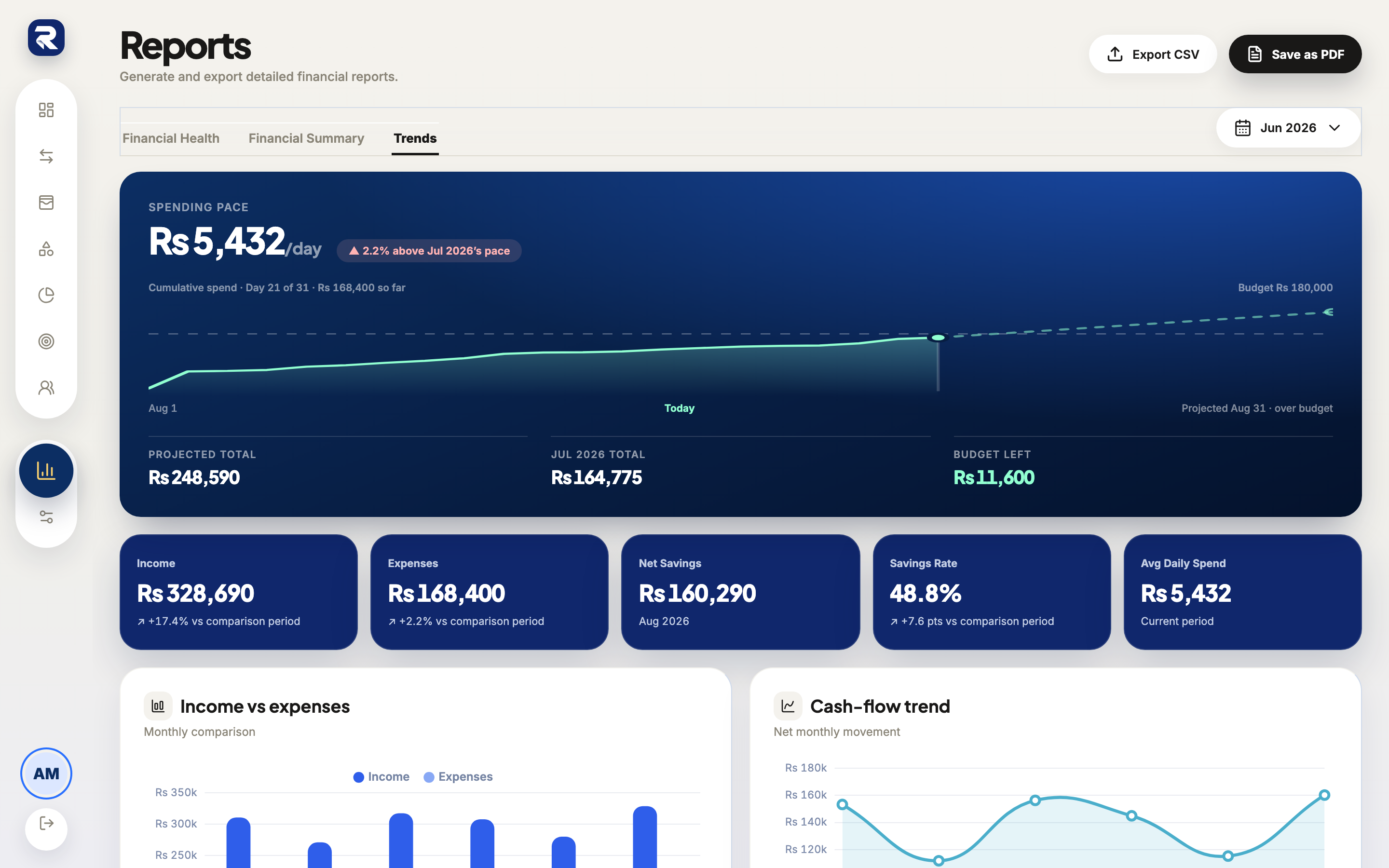
- Use the monthly trend in Reports to watch income variance directly — that chart is where the floor comes from.
Where Rakama stops
It does not calculate a floor for you, does not forecast income, does not set aside tax, and does not warn you that three low months in a row have drawn the buffer down. Those are judgements, and this method needs you to make them roughly twice a year and after every unusually good month. What the app supplies is the history to make them from, and a place to keep the buffer where you will not spend it by accident.
Frequently asked questions
How do you budget when your income changes every month?
Budget against your income floor — the amount you can be confident of receiving in a bad month — rather than your average. Everything above the floor is allocated when it arrives, not planned in advance.
What is an income floor?
The lowest monthly income you would be surprised to fall below, based on your own history. For most people with variable income it sits well under the average and slightly under the median.
Why not just budget on my average income?
Because you cannot spend an average. In any month below it you are short, and being short is a far bigger problem than being unexpectedly ahead.
How many months of history do I need?
Twelve is ideal because it covers a full seasonal cycle. Six is workable. Below that, be conservative — use your lowest month and revisit once you have more data.
Make your money easier to understand.
Track expenses, plan budgets, and keep your goals in one clear view with Rakama.
Try Rakama free ↗