
Most people who hold two currencies want one number, and spend a surprising amount of effort trying to get it. The setup below does not produce that number — and turns out to answer every question you actually had, without a single figure in it being an estimate.
Why not to combine them
A combined total has a property no other number in your ledger has: it changes when nothing has happened.
You go to bed with a net worth of Rs 4.2 million. The rate moves overnight. You wake up with Rs 4.35 million. No transaction occurred, no decision was made, and you are now Rs 150,000 richer according to a number you cannot check against anything.
Worse, the effect is asymmetric in how it feels. A favourable move reads as progress you did not make; an unfavourable one reads as a loss you did not incur. Both distort the only thing net worth is good for, which is noticing genuine change.
The setup
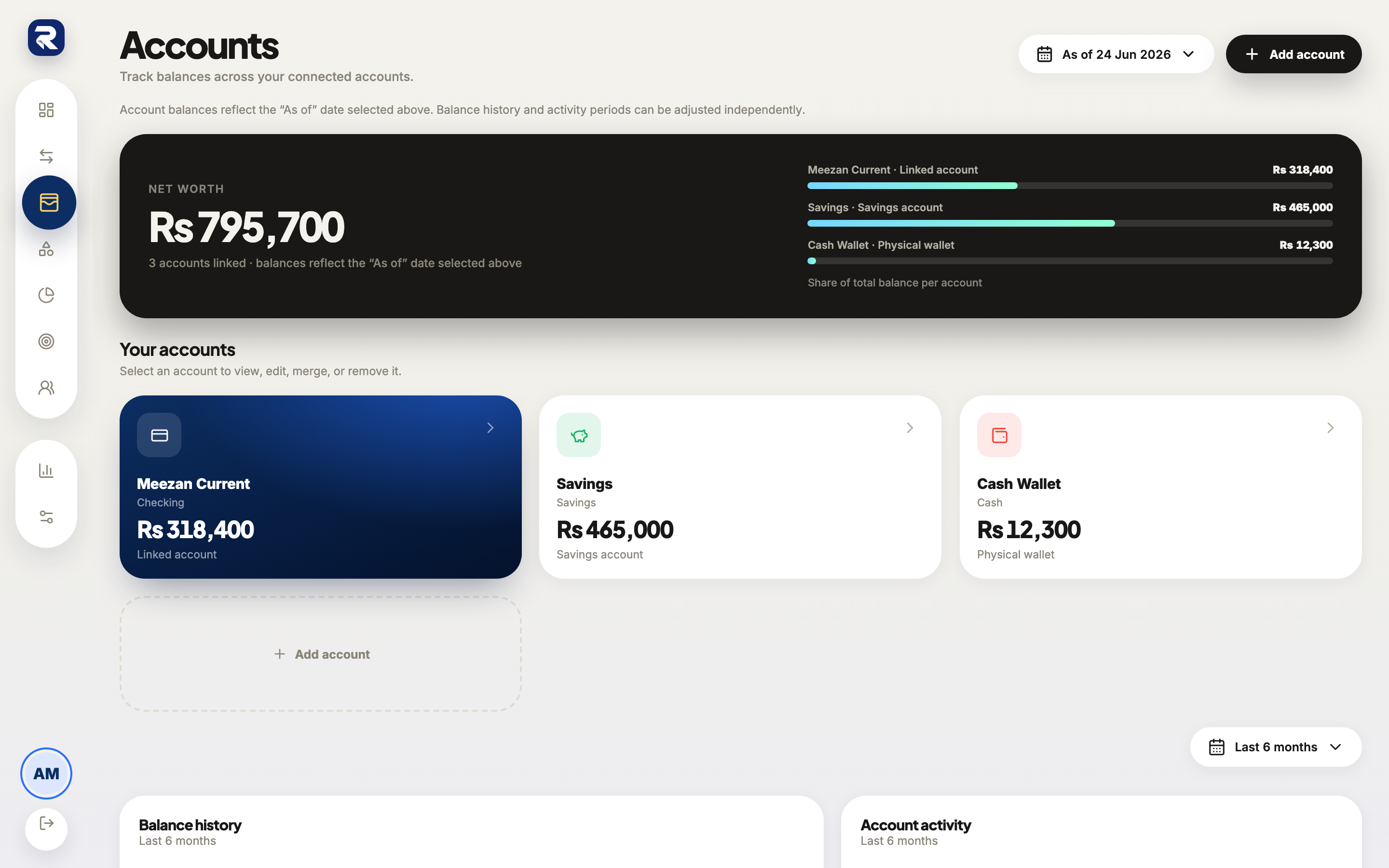
One account per currency, per purpose
- Foreign current — where payments in the earning currency arrive.
- Local current — where converted money lands and daily life is funded.
- Local buffer — the reserve, in the currency your obligations are in.
- Foreign savings — only if you are deliberately holding that currency, and only for reasons you can state.
Note where the buffer sits. It belongs in the currency your rent is due in, because a buffer whose value moves against your obligations is smaller than it looks on precisely the days it matters.
Budgets in the spending currency only
If ninety-five percent of your spending is local, all of your budgets are local and the foreign account is a staging area rather than something you budget from. It has an inflow and an outflow and no categories at all.
Recording a conversion
Two entries, both at their real amounts:
| Leg | Account | Amount |
|---|---|---|
| Out | Foreign current | $2,000 |
| In | Local current | Rs 558,000 |
Neither is spending and neither is income — the money has moved, not been consumed. Both balances end correct. Your effective rate for that conversion is 279, recoverable at any time by dividing one by the other, and it includes every fee and spread whether or not anyone told you about them.
One thing to be aware of: Rakama’s linked transfer expects a single amount moving between two accounts, so a cross-currency move is recorded as two entries you make yourself rather than as one linked pair. That means it will not be excluded from spending automatically the way a same-currency transfer is — categorise both legs as transfers so they stay out of your spending figures.
The questions you can still answer
Everything you were actually going to ask, without a combined total anywhere:
- "Can I pay rent this month?" — look at the local current balance.
- "How long could I survive with no income?" — local buffer divided by minimum monthly costs.
- "How much am I earning?" — the foreign account’s inflows, in their own currency.
- "What is converting costing me?" — the effective rates of your last twelve conversions against the interbank rate on those dates.
- "Am I getting ahead?" — each account’s balance a year ago against today, compared separately.
The one question it does not answer is “what am I worth?”, and that question has no single correct answer while you hold two currencies. You can produce a figure for a specific purpose — a visa application, a loan form — by picking a rate and stating it. That is a deliberate act, done once, with the rate written down. Which is exactly the treatment it deserves.
Frequently asked questions
Can I track two currencies in Rakama?
Yes — accounts hold a currency and you can keep as many as you need. What Rakama will not do is convert between them or show a combined total.
How do I record moving money between currencies?
As two entries at their real amounts: money leaving the foreign account and money arriving in the local one. The difference is the conversion cost.
How do I see my total net worth across currencies?
You do it yourself, at a rate you choose, when you actually need the figure. That is less convenient and considerably more honest than a total that drifts overnight.
Should budgets be per currency?
Budget in the currency you spend. If you spend almost entirely in one, that is the only currency your budgets need to be in.
Make your money easier to understand.
Track expenses, plan budgets, and keep your goals in one clear view with Rakama.
Try Rakama free ↗