
Your client pays $2,000 a month, reliably, on the first. Your rent is Rs 85,000, due on the fifth. Neither number changes — and yet some months are comfortable and some are tight, because a third number that nobody consulted you about sits between them.
The second variable
A cross-currency income has an unusual property: it is simultaneously the most stable and the least stable income there is. In its own currency it may not move for years. In the currency you actually live in, it moves every day.
This produces a specific confusion. You think of yourself as having a fixed income because the invoice says so, and then you are repeatedly surprised by months that feel different for no reason you did anything to cause.
| Month | Earned | Rate | In rupees |
|---|---|---|---|
| January | $2,000 | 278 | Rs 556,000 |
| April | $2,000 | 291 | Rs 582,000 |
| July | $2,000 | 265 | Rs 530,000 |
| October | $2,000 | 302 | Rs 604,000 |
A Rs 74,000 spread on an income that never changed. That is close to a month of rent, appearing and disappearing without any decision on your part.
The one rule that fixes most of it
This sounds obvious and is routinely violated by people who think of their income as “$2,000 a month” and then do the conversion in their head at whatever rate they last noticed. The rate they last noticed is almost always a good one, because good rates are the ones people remark on.
Every budget figure, every category limit, every buffer target: denominated in the currency your obligations are in. The dollar amount is an input to a conversion, not a plan.
Setting a floor in the spending currency
The income floor idea applies here with one modification: it has to absorb rate movement as well as income movement.
- Take your reliable income in the earning currency — the amount you would be surprised to fall below.
- Take a conservative rate: your lowest rate over the last two years, not today’s.
- Multiply. That is your floor, in the currency you spend.
At $2,000 and a two-year low of 258, the floor is Rs 516,000 — noticeably under the Rs 604,000 an October would suggest. Commit to obligations that fit inside Rs 516,000, and every month above it produces surplus rather than relief.
Which direction the risk runs
If your local currency has been weakening, the rate has been moving in your favour and it is tempting to plan on that continuing. Be careful with this. A trend that has run for years can pause for a year, and a budget built on continued depreciation is a budget with a directional bet inside it that you did not consciously make.
The conservative rate is not a prediction that the trend reverses. It is a refusal to require that it continues.
What your ledger should hold
The temptation is to convert everything into one currency so you can see a single net worth figure. Resist it, for a reason that is practical rather than purist: a converted total changes when nothing has happened, and a ledger whose numbers move on their own is a ledger you cannot check.
- Each account holds one currency — the one the money is actually in.
- Income is recorded in the account it arrived in, at the amount that arrived.
- A conversion is two entries: money out of the foreign account, money into the local one, at the rate you actually got.
- The difference between the amounts is the conversion cost, and it is worth being able to see.
That last point is quietly valuable. Recording both legs at their real amounts means the spread and fees are visible as a number rather than absorbed into a rate you assumed. Over a year of monthly conversions, it is usually larger than people expect.
What Rakama does and does not do
Stated plainly, because this is the area where an app can most easily mislead you:
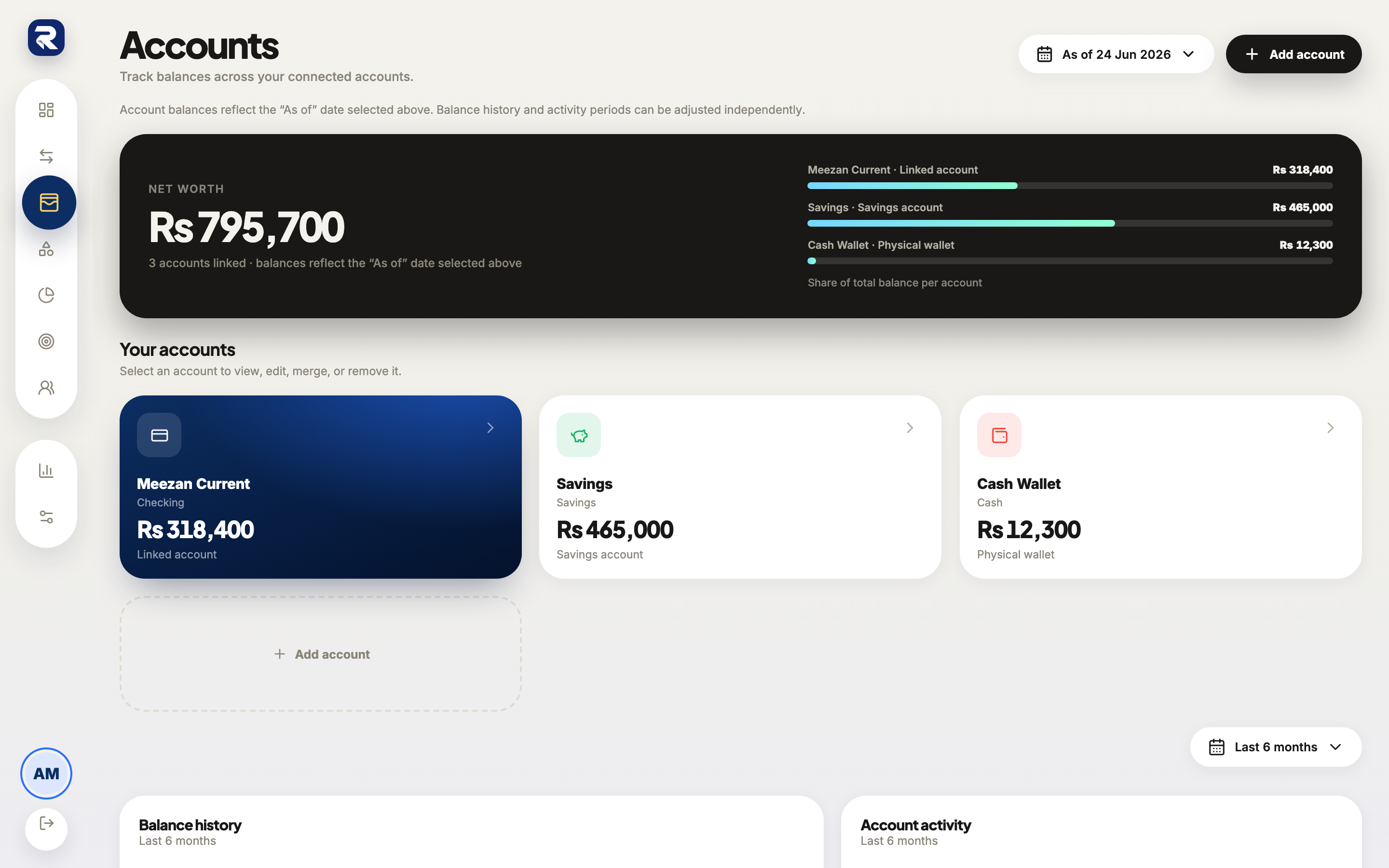
- Accounts have a currency. Rakama holds them separately and does not convert between them.
- There is no exchange-rate feed, no automatic conversion, and no combined multi-currency net worth.
- A conversion is recorded by you, as two entries, at the rate you actually received.
- Business documents are the one exception: an invoice is written in the customer’s currency with base-currency amounts stored alongside, for the books.
This is a limitation and it is also, for this particular problem, the safer behaviour. What Rakama gives you is separate balances that are each exactly right, and a history of conversions at the rates you genuinely got — which is the raw material for the floor, and for knowing what the converting itself has cost you.
Frequently asked questions
How do I budget when I earn in dollars and spend in rupees?
Budget entirely in the currency you spend, and set your income floor using a conservative exchange rate rather than the current one.
Should I record income in the currency I was paid in?
Record what landed in each account, in that account’s currency. The conversion is a real event with a real rate — record it when it happens, not notionally.
Does Rakama convert between currencies?
No. Accounts hold a currency and Rakama does not apply exchange rates or combine currencies into a single total. Business documents keep base-currency amounts alongside, but personal accounts do not convert.
What rate should I use for planning?
A rate meaningfully worse than today’s. Planning at the current rate means every adverse move is a shortfall.
Make your money easier to understand.
Track expenses, plan budgets, and keep your goals in one clear view with Rakama.
Try Rakama free ↗