
Six invoices go out on the last day of every month, for roughly the same total each time. On paper that is a salary. In practice one client pays in three days, two pay in three weeks, one pays when chased, one pays half now and half later, and one has been silent since June.
The gap between invoiced and received
Invoicing monthly creates a comforting illusion of regularity that your bank balance does not share. The useful move is to stop looking at the invoiced figure as income at all, and start treating it as what it is: a claim, with a probability and a date attached.
| Month | Invoiced | Received | What the budget sees |
|---|---|---|---|
| June | Rs 180,000 | Rs 95,000 | Rs 95,000 |
| July | Rs 175,000 | Rs 240,000 | Rs 240,000 |
| August | Rs 190,000 | Rs 110,000 | Rs 110,000 |
Three months of near-identical invoicing produced income of Rs 95k, Rs 240k and Rs 110k. A budget built on Rs 180,000 a month fails twice out of three. A budget built on an income floor derived from the received column survives all three.
Two ledgers, one of them yours
You need both records, and the mistake is trying to keep them in one place.
- The receivables list: who owes what, since when. This drives chasing, pricing, and whether to take on a client again.
- The cash ledger: what actually arrived and where it went. This drives your budget, your floor and your buffer.
Merging them produces a ledger where your balance is wrong, and a receivables list that quietly deletes its own history the moment an invoice is paid. Keeping them apart costs nothing and each one then does its job properly.
The money that is not yours
Nobody withholds tax from a freelance payment. The entire amount lands in your account, looks like yours, and some fraction of it is not.
The only reliable method is to move it on the day the payment arrives. Not monthly, not quarterly, and certainly not at year end — by then it has been spent, and the shortfall is discovered at exactly the moment it is least convenient.
- A separate savings account, named for tax. Not a mental earmark inside your current account.
- A transfer the same day each payment lands, before you look at the balance and form an impression of how the month is going.
- If unsure of the rate, set aside more. Discovering you over-provided is a good day; discovering the opposite is not.
Because it is a transfer, Rakama keeps it out of your spending figures entirely. The money sits in an account you can see, is not counted as saving, and is not available to spend — which is exactly its status.
A setup that works
Accounts
- Current — where client payments land and normal life is funded.
- Tax — a transfer on the day of every payment received.
- Buffer — the timing and thin-month reserve.
- Cash — if any part of your work is paid in notes.
The routine, per payment
- Record the income to Current, dated the day it cleared, for the amount that actually arrived.
- Transfer the tax share to Tax.
- If the buffer is below target, transfer to it next.
- What remains is the month’s money.
The routine, twice a year
Recalculate the income floor from received income only, check whether the buffer target still matches your longest bad run, and look at the receivables list for the client patterns you have been tolerating.
When to use business mode
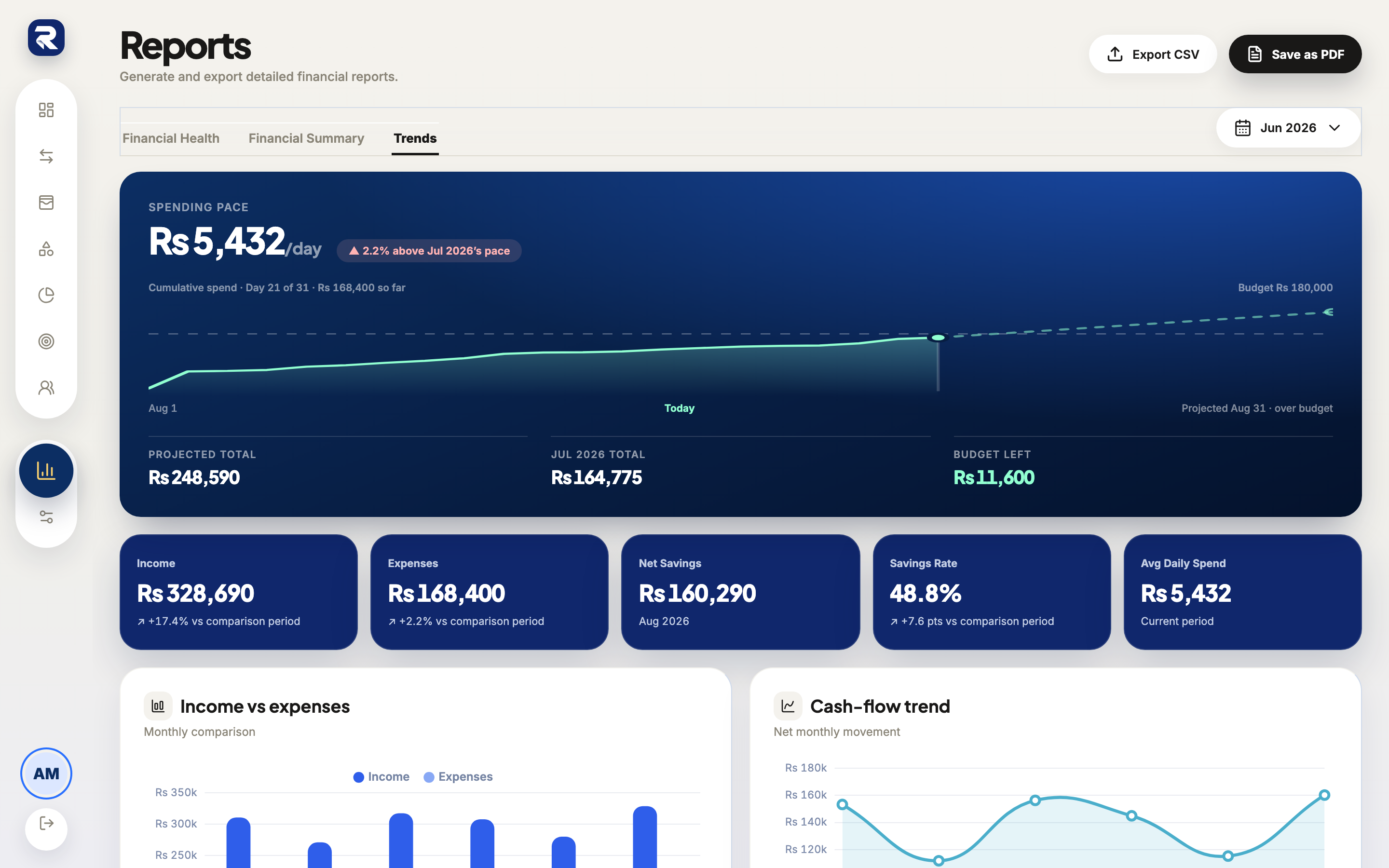
Rakama has a business mode that adds customers, invoices, bills and business reports. It is worth turning on if you invoice regularly, and worth understanding precisely.
- Invoices are documents, not transactions. Raising one does not touch any balance.
- Recording a payment against an invoice is the only thing that moves cash.
- Documents are written in the customer’s currency, with the base-currency amounts kept alongside for the books.
- It does not chase anyone, does not calculate your tax, and does not forecast when an invoice will be paid.
That first pair of rules is the reason business mode does not break the discipline this post is about. The separation between issuing an invoice and receiving money is enforced by the data model rather than by your restraint — which is the right place for it.
Frequently asked questions
Should freelancers budget on invoiced or received income?
Received. Invoiced money cannot pay a bill, and recording it early makes your account balance stop matching your bank.
How much should I set aside for tax as a freelancer?
Whatever your bracket requires, moved on the day each payment arrives rather than calculated at year end. If you are unsure, set aside more and correct downward once you know.
Does Rakama track invoices?
Business mode does — invoices are separate documents, and cash only moves when you record a payment against one. Personal accounts have no invoice concept.
Should I keep business and personal money in the same app?
Keep the accounts separate. Your drawings from the business are income to you, and that is the only line that should cross.
Make your money easier to understand.
Track expenses, plan budgets, and keep your goals in one clear view with Rakama.
Try Rakama free ↗