
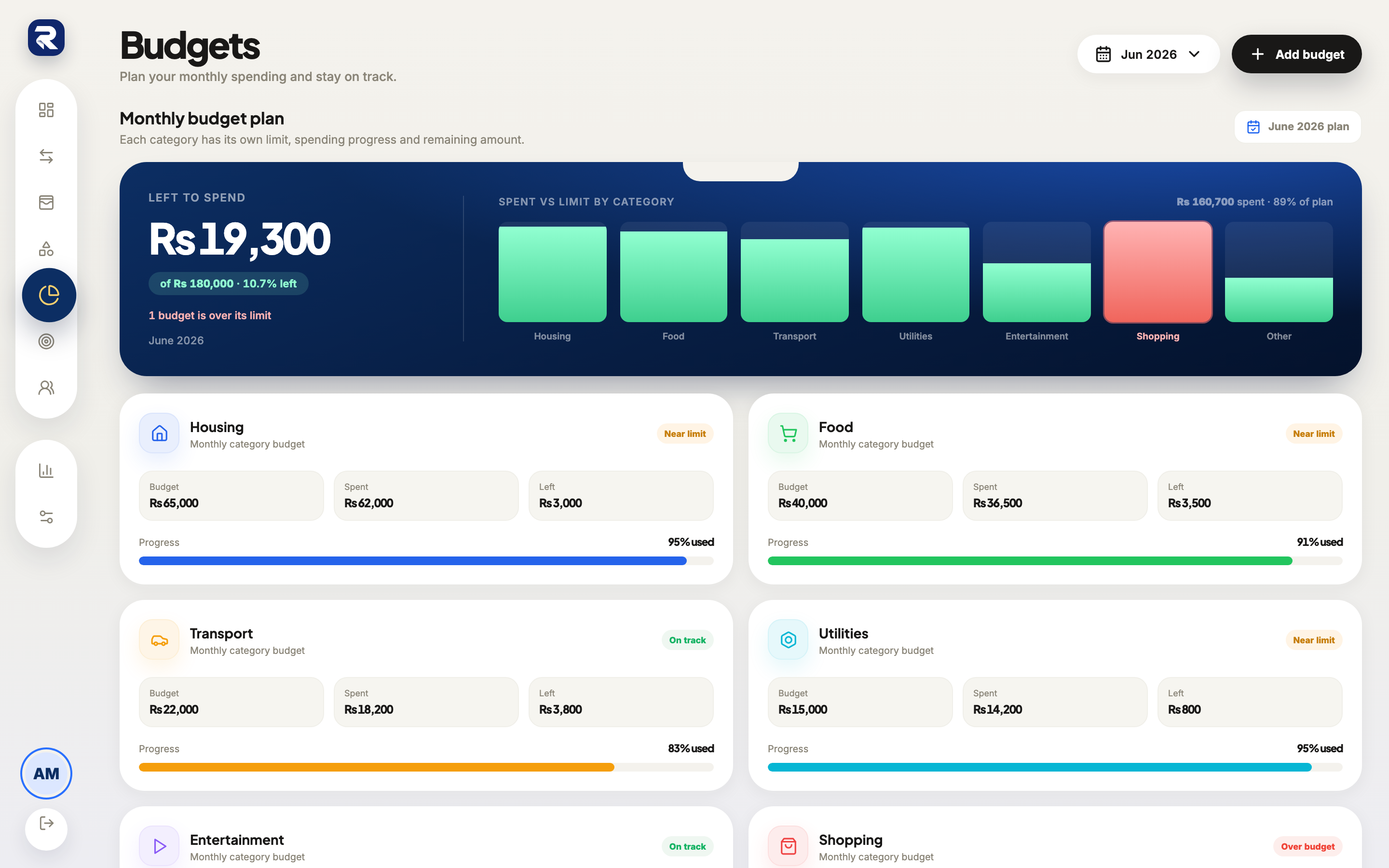
You set a grocery budget of Rs 40,000 in January after two careful months of tracking. By August you are spending Rs 52,000 on the same list, from the same shop, cooking the same food. Nothing about your behaviour changed. The budget did not become wrong — it stopped being about anything.
The quiet failure
A budget in a stable economy is a decision you make once and check against. In a high-inflation economy it is a measurement that expires, and the expiry has no date on it.
The failure is quiet because every month looks like a small overspend rather than a structural problem. Rs 2,000 over in March, Rs 4,000 in May, Rs 12,000 in August — at no point does a single month announce that the limit is obsolete, so people spend the year feeling mildly undisciplined about something that was never a discipline problem.
Reviewing on a schedule
The fix is calendar-driven rather than feeling-driven. Pick four dates a year and hold them.
- Open the last three months of spending by category.
- For each category, compare the actual average against the limit.
- Where actual has exceeded the limit for all three months, raise the limit to the actual.
- Where actual has come in well under, lower it — the freed amount is what funds the raises.
- Write down the date you did this.
The last step matters more than it sounds. Knowing that your budgets are current as of three weeks ago versus eight months ago is the difference between a number you can act on and a number you have to interpret.
Quarterly is the right cadence. Monthly turns budgeting into a chore and makes you chase noise; annually means running an obsolete budget for most of the year.
Which categories move first
Inflation does not arrive uniformly, and knowing the order tells you where to look.
| Category | How fast it moves | Review it |
|---|---|---|
| Food and groceries | Fastest — repriced continuously | Every quarter, without fail |
| Fuel and transport | Fast, and steps rather than drifts | Every quarter |
| Utilities | Lagging but large when it moves | Watch for step changes |
| Rent | Annually, in one jump | At renewal |
| Subscriptions | Slow, easy to miss | Once a year |
The step-change categories deserve particular attention. A utility tariff that rises forty percent in one month does not produce a gradual drift you might notice — it produces one bad month followed by a permanently higher baseline, and it is very easy to treat the first as an anomaly and never revisit the limit.
Comparing months honestly
Year-on-year comparison, the standard tool of personal finance, becomes actively misleading when the unit of measurement is shrinking. “Spending is up eighteen percent” tells you almost nothing about whether you are living differently.
Two comparisons that survive:
- Category as a share of total spending. If groceries were 22% of your outgoings last year and 24% now, that is a real change in shape, independent of price levels.
- Savings rate. Saved divided by earned, both in the same month, in the same currency. Inflation affects both sides and the ratio stays meaningful.
Both are ratios, which is the point — a ratio of two numbers measured in the same shrinking unit is stable when neither number is. This is why the savings rate is the most durable single figure in a high-inflation budget, and worth watching in preference to any absolute amount.
What can actually be protected
Honestly: not much of it, and the useful move is to be clear about which parts.
- Fixed-rate debt gets cheaper in real terms. This is one of the few genuine benefits and it happens without you doing anything.
- Cash savings lose value continuously. A buffer is still necessary, but its size should be reviewed at every quarterly check, not set once.
- Income needs revisiting on the same schedule as costs. A rate you set two years ago has taken a real-terms cut you did not agree to.
- Stockpiling non-perishables ahead of a known price rise works, in a small way, for a small set of goods.
What does not work is trying to hold the line on the budget itself. The prices are not negotiating with you, and a limit maintained past its usefulness converts an economic condition into a personal failing. Raise the number, note why, and keep the record honest — that record is the only thing that will let you see what actually happened when you look back at the year.
Frequently asked questions
How often should I update my budget during high inflation?
Every quarter, on a fixed date, whether or not you feel it is necessary. Waiting until a budget feels wrong means running a wrong budget for months first.
Why does my spending keep rising when my habits have not changed?
Because your spending is measured in units that are shrinking. The quantities are constant and the prices are not.
Are year-on-year spending comparisons useful during inflation?
Only as totals. To compare habits, look at each category as a share of total spending — shares stay meaningful when amounts do not.
Does Rakama adjust budgets for inflation?
No. Budgets are fixed amounts you set, and nothing changes them automatically. The quarterly review is yours to do.
Make your money easier to understand.
Track expenses, plan budgets, and keep your goals in one clear view with Rakama.
Try Rakama free ↗