
The envelope system is the oldest personal-finance method that still works, and it works for one reason that has nothing to do with budgeting: when the envelope marked “eating out” is empty, you cannot eat out. The constraint is physical. No app has ever managed to reproduce that, and most stop pretending somewhere around the third notification you dismissed.
Why envelopes work
Cash your salary, divide it into labelled envelopes, spend only from the relevant one. The method has three properties that most digital budgets lack entirely:
- The limit is enforced at the moment of purchase, not reported afterwards.
- The remaining amount is visible without a decision to check it — you see it when you open the envelope.
- Borrowing between categories requires a deliberate physical act you will remember doing.
Compare with a budget alert: it arrives after the purchase, requires you to open something to see the state, and overspending needs no act at all. It happens by default.
What software cannot reproduce
| Envelope property | Digital equivalent | Survives? |
|---|---|---|
| A limit per category | A monthly budget | Yes, fully |
| Spending tracked against it | Budget progress | Yes, fully |
| You physically cannot exceed it | A notification | No |
| Remaining amount always in view | A screen you must open | Partly |
| Moving money between envelopes is deliberate | Nothing | No |
The two rows that fail are the two that made the system work. Everything software is good at — arithmetic, history, categorisation — envelopes were never good at. Everything envelopes were good at, software structurally cannot do, because it does not control your hands.
The hybrid that actually works
Stop trying to make one system do both jobs. Use physical envelopes where the constraint matters and digital budgets everywhere else.
Physical envelopes: two or three categories only
The ones where you overspend, and where overspending is a decision made in the moment rather than a bill that arrives. For most people that is eating out, small shopping, and whatever their particular weakness is. Put the month’s allowance in an envelope on payday and spend from it.
Three envelopes is manageable. Twelve is why the original method has a reputation for failing — not because the idea is wrong, but because nobody carries twelve envelopes.
Digital budgets: everything else
Rent, utilities, fuel, groceries, subscriptions. These are either fixed, or paid by card, or too large to hold in cash. A budget that reports after the fact is perfectly adequate for spending you were not going to impulsively double anyway.
Doing it in Rakama
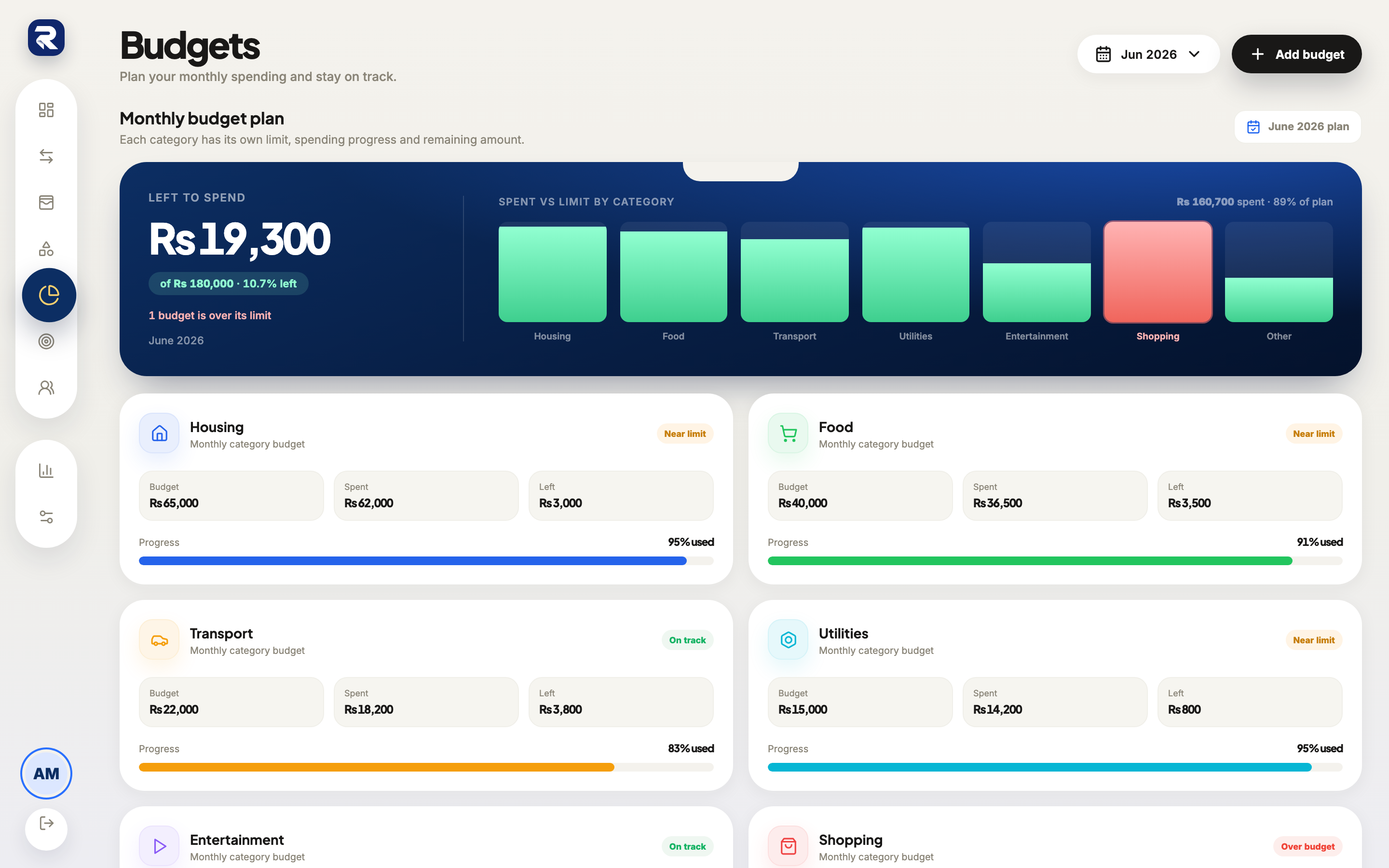
The envelopes stay in your pocket; the app records what came out of them.
- Set a monthly budget for each envelope category, equal to what you put in the envelope.
- Record purchases from those envelopes as cash expenses in that category.
- The budget bar and the physical envelope should agree. When they do not, the envelope is right and you have missed an entry.
That last line is the useful part of the hybrid: the envelope becomes a second, independent record. Most cash tracking has no check at all until the weekly count. An envelope gives you one per category, continuously.
What Rakama does not do
- No envelope feature. Budgets are limits on categories, not ring-fenced pots of money.
- No rollover. A budget resets each month; an unspent surplus does not carry forward.
- No block on overspending. Rakama will record an expense that takes you past a limit without objection.
- No per-envelope cash balance. Your cash account holds one total, however many envelopes it is divided into physically.
None of that is a gap to be filled later. A budgeting app that refused to record a transaction would be an app that makes your ledger false in order to make you feel disciplined, and there is no version of that trade worth taking.
Frequently asked questions
Can I do envelope budgeting in an app?
Partly. Budgets reproduce the limits and the tracking, but not the physical constraint of an empty envelope. Keep envelopes for the two or three categories where you actually overspend.
Does Rakama have an envelope feature?
No. Budgets are per-category monthly limits, which is the digital half of the method. There is no ring-fenced pot of money per category.
How many envelopes should I use?
Three or four physical ones at most. The classic twelve-envelope system fails on volume, not on principle.
Can leftover envelope money roll over?
Physically, yes — you just leave it there. Rakama budgets reset monthly and do not carry a surplus forward, so the rollover lives in the envelope, not in the app.
Make your money easier to understand.
Track expenses, plan budgets, and keep your goals in one clear view with Rakama.
Try Rakama free ↗