
A cash count is the smallest possible piece of bookkeeping: you look at how much money you have, compare it with how much you thought you had, and write down the difference. It takes five minutes and it is the reason a cash-heavy budget can be trusted at all.
What a count is actually for
Not accuracy for its own sake. A count does two specific jobs.
- It resets your cash balance to the truth, so the number in the app is worth looking at.
- It measures how much you are not recording — which is information you cannot get any other way.
The second is the one people underrate. Everything else in your ledger is a claim; the count is the only measurement. It is the one moment in the week where the app is checked against reality rather than against itself.
Choosing the moment
The single biggest predictor of whether this habit survives is whether it is attached to something you already do. Not a reminder — an attachment.
Good anchors: Sunday evening, after the week’s last errand. The moment you get home on the day you do the big grocery run. Right before you top up your wallet, since you are already looking at it.
The count itself
Step one — gather
Wallet, coat pocket, the car, the drawer, the emergency note folded behind your ID. All of it in one place. Money you forgot about is the most common cause of a count that disagrees with last week’s count in the wrong direction.
Step two — count and write it down
Say the number out loud or type it somewhere before you open the app. This matters more than it sounds: if you look at the expected balance first, you will unconsciously count towards it, and the whole exercise becomes theatre.
Step three — compare
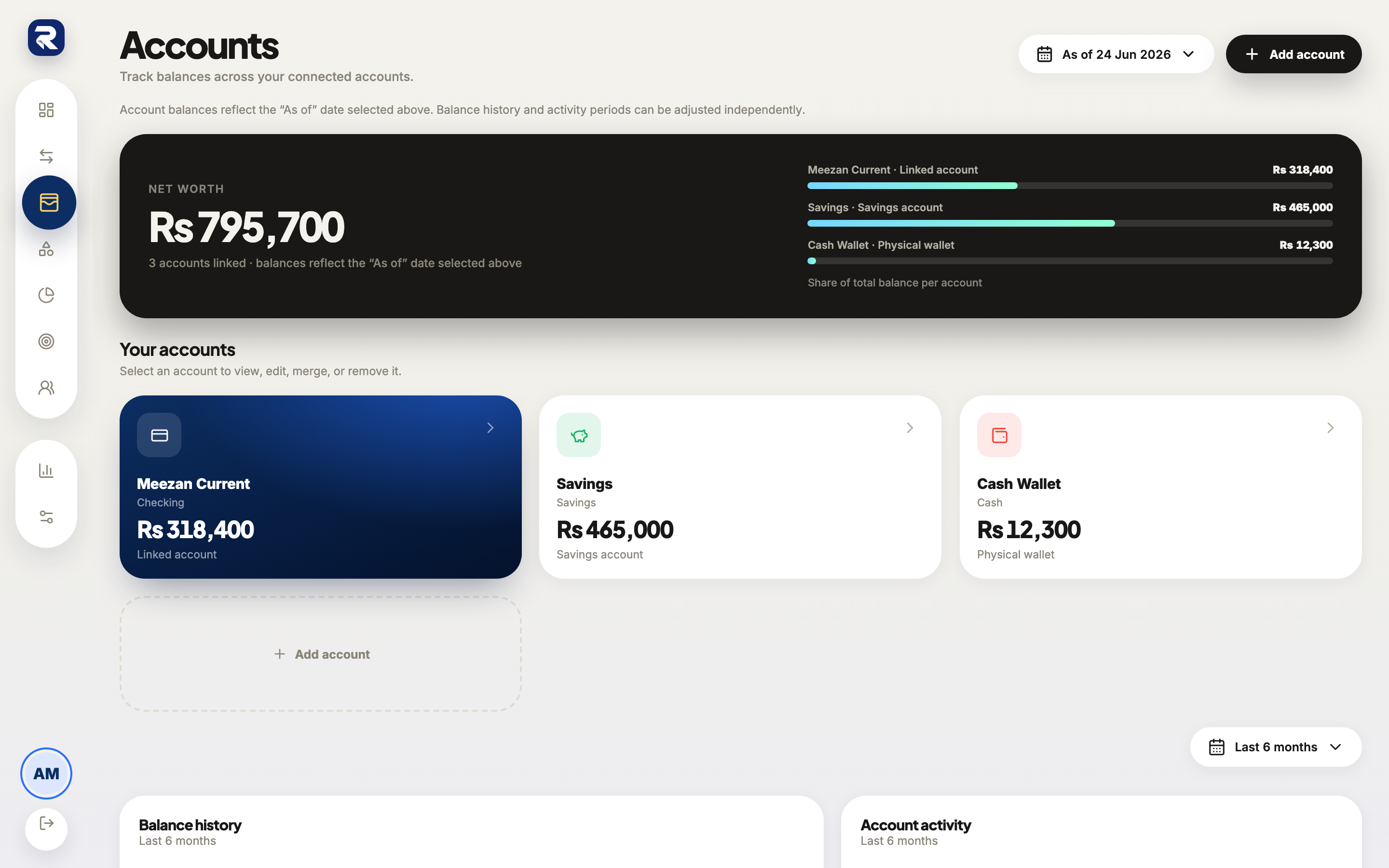
Open the accounts list and read the cash balance. The difference between that and your counted number is the week’s unrecorded spending.
Making the entry
One expense. Dated today. Amount equal to the difference. Account: Cash.
For the category, spend three seconds on an honest guess rather than reaching for Miscellaneous by reflex. “It was mostly food and rickshaws” is real information; splitting Rs 3,000 into Rs 2,000 food and Rs 1,000 transport is more useful than one anonymous lump, and you are allowed to enter two adjustments instead of one.
Then stop. Do not go back through the week trying to reconstruct what the money was. That reconstruction is unreliable, takes twenty minutes, and produces entries that look authoritative while being invented — which is worse than one entry that is honestly labelled as a correction.
Three awkward cases
You are holding money that is not yours
Collected for a group gift, holding a relative’s cash, carrying the shared household float. Count it separately and leave it out of your balance. If it is a recurring arrangement, give it its own account so it stops confusing every future count.
Foreign notes in the wallet
Leave them out. Rakama holds accounts in a currency and does not convert between them, so folding a hundred-dirham note into a rupee balance means inventing an exchange rate your ledger cannot show. Count it as a separate pile in your head.
You missed a week
Count anyway and take the whole two-week difference as one entry. A large adjustment is not a failure; skipping the count because the adjustment would be embarrassing is how people quietly abandon the method entirely.
Frequently asked questions
How often should I count my cash?
Once a week is the sweet spot. Daily is too much effort for the information gained; monthly makes each correction too large to attribute to anything.
What do I do with the difference?
Enter it as one expense dated today, in the category you believe most of it belongs to. Never edit past transactions to close the gap.
Should I count money I am holding for someone else?
Count it, then exclude it. Money you are holding for a shared purchase or on behalf of family is not yours to spend, and folding it into your balance overstates what you have.
What if the app balance is lower than my wallet?
Usually a double-recorded withdrawal or a transfer entered as an expense. Look at the last few cash entries before adding a positive adjustment.
Make your money easier to understand.
Track expenses, plan budgets, and keep your goals in one clear view with Rakama.
Try Rakama free ↗