
The app says Rs 12,400. Your wallet contains Rs 9,150. Nothing was stolen, you have not forgotten a large purchase, and you have been reasonably careful — and still there is Rs 3,250 unaccounted for. This happens to everyone who tracks cash, permanently, and it has a specific cause.
Where the gap comes from
Unrecorded transactions are not symmetric. Think about what it takes to miss an entry in each direction.
| Direction | How you would miss it | How often that happens |
|---|---|---|
| Money leaving | Buy something small, do not open the app | Several times a week |
| Money arriving | Withdraw cash or get paid back, forget it entirely | Almost never |
Cash arrives in lumps — a withdrawal, a repayment, a gift — and lumps are memorable. It leaves in fragments, and fragments are not. So the errors accumulate in one direction only, and the app balance is reliably too high, never too low.
Three things the gap is not
It is not a sync problem
Nothing anywhere knows how much cash you are holding. No bank feed, no import, no background process. The number in the app is the sum of what you told it, and that is the whole mechanism.
It is not a rounding error
Rakama stores every amount in integer minor units, so nothing is being lost to floating point. A Rs 3,250 gap is Rs 3,250 of real purchases you did not enter.
It is not a personal failing
The expected value of recording a Rs 40 purchase is close to zero and the cost is fifteen seconds of attention while somebody waits for change. Not recording it is a rational choice, made many times. The method has to survive that, because the choice is not going to change.
Measure it instead of fixing it
Reframe the gap as a statistic about you rather than an error to eliminate, and it becomes genuinely useful.
- Under 5% of monthly cash spending: normal. Absorb it and stop thinking about it.
- 5–10%: you are missing a recurring habit, not scattered small buys. Look for something you do most days.
- Over 10%: the method is not being applied. Usually cash purchases are being skipped entirely for stretches.
- Varies wildly month to month: you are recording carefully in some weeks and not at all in others — which is worse for comparisons than consistently missing the same fraction.
That last point is the counter-intuitive one. Steady under-recording still gives you usable trends, because the bias is constant. Erratic recording gives you a chart where a quiet month and a diligent month look the same.
The one-entry correction
Count what is in your wallet. Subtract from the app balance. Add one expense, dated today, for the difference.
Choose the category deliberately. If you know most of the missing money went on food, put it in food — that is more accurate than Miscellaneous even though it is an estimate, because you are estimating something you actually have information about. Only use Miscellaneous when you genuinely have no idea.
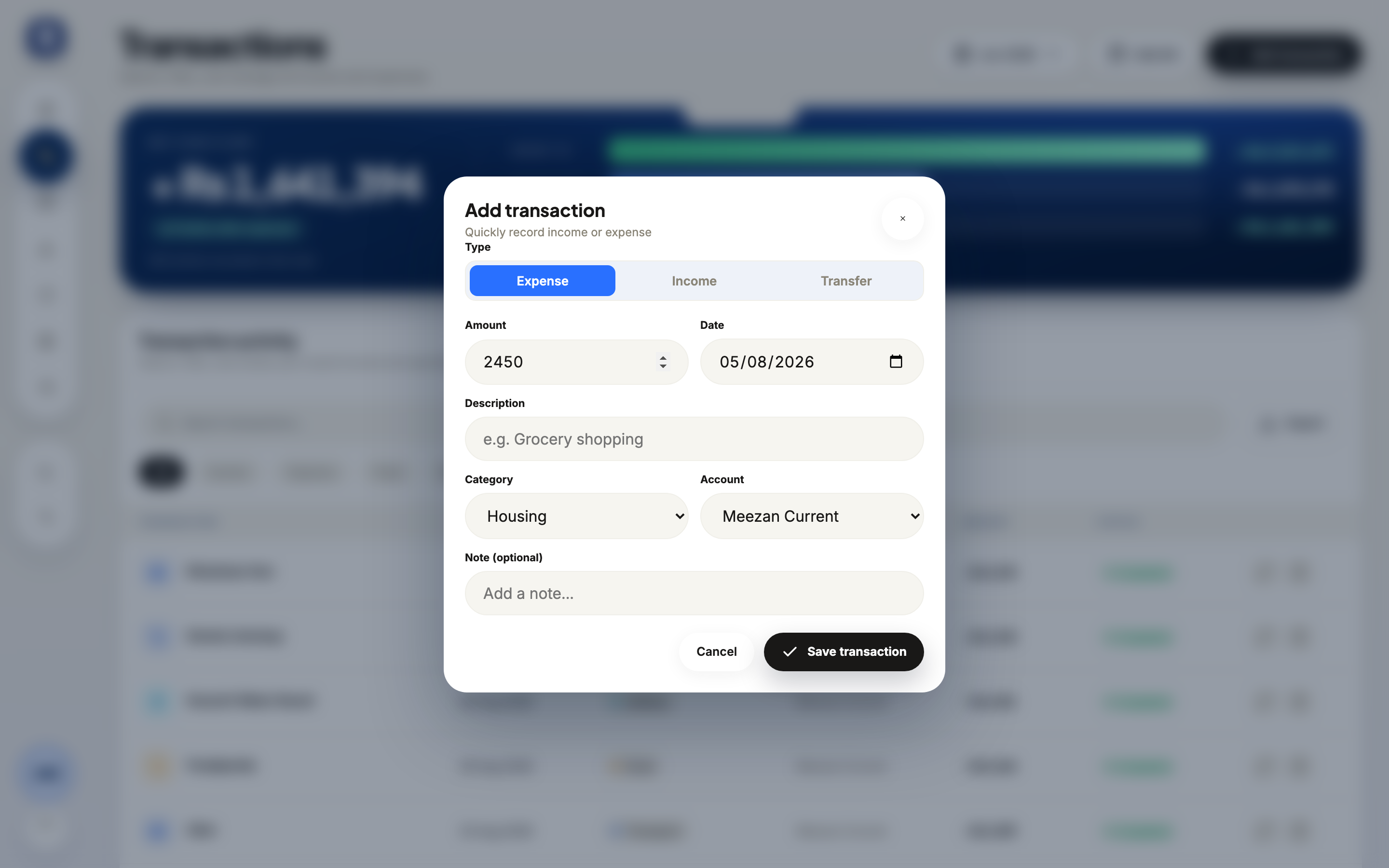
Do not date it to the start of the week, and do not spread it across days. It is a measurement you made today; dating it today is the honest record of when you learned it.
Shrinking the gap, if you want to
You do not have to. But if the size of it bothers you, these three moves are worth more than trying to be more disciplined:
- Withdraw smaller amounts more often. A wallet holding Rs 5,000 produces a smaller absolute gap than one holding Rs 20,000, and you notice the drain sooner.
- Give recurring small buys their own category. Once "chai" exists as a category, entering one takes two taps and stops feeling like paperwork.
- Count twice a week instead of once. The gap does not shrink, but each correction is small enough to attribute to something real.
What does not work: promising to record everything. That has been tried, by everyone, and the eleven-day failure is so reliable you could set a calendar by it.
Frequently asked questions
Why is my cash balance in the app always higher than my wallet?
Because unrecorded purchases only ever go one way. Money leaves your pocket without an entry far more often than it enters one, so the app balance drifts upward relative to reality.
Should I edit old transactions to make the balance match?
No. That destroys records you know are correct in order to compensate for records you know are missing. Add one adjusting entry dated today instead.
How big should the gap be?
Two to five percent of your monthly cash spending is normal. Consistently more than ten percent means the method is not being followed, not that the method is wrong.
Does Rakama have a cash reconciliation feature?
There is a reconcile flow for accounts, but for cash the practical approach is a weekly count and a single adjusting expense.
Make your money easier to understand.
Track expenses, plan budgets, and keep your goals in one clear view with Rakama.
Try Rakama free ↗