
The budgeting advice available in English was mostly written for people whose spending records itself. Tap a card, and a line appears with a merchant name, an amount and a date, and the only work left is to argue with the category. If you pay the vegetable seller in notes, none of that happens, and the standard advice quietly becomes a request that you remember everything.
Why card-shaped apps fail on cash
The failure is structural rather than a missing feature. A card-first app assumes three things that are simply not true of cash:
- That every outflow has a merchant name attached to it.
- That the record arrives without you doing anything.
- That your balance is authoritative — the bank knows it, you do not have to.
Cash inverts all three. The record only exists if you make it, the merchant is “the man near the bus stop”, and the balance is whatever is actually in your pocket, which nobody but you can check.
The usual response — try harder, log everything — fails for a boring reason: the cost of logging a Rs 40 purchase is higher than the information it produces, so people stop within about eleven days. Any method that survives has to accept partial recording as normal and be correct anyway.
The one principle
Nearly every cash-budgeting problem is a consequence of ignoring this. Treat the ATM withdrawal as spending and you count the money twice — once as “Cash” and again as groceries. Treat cash as untracked and your budgets are silently missing a third of your life. Treat it as a place with a balance and both problems disappear at once.
Everything below is the mechanical consequence of that one sentence. If you take nothing else, take that.
The method
1. Make cash an account
Not a category called “Cash” — an account, sitting in the same list as your bank. Open it with the amount currently in your wallet, counted, on the day you start. Not an estimate; estimates are the origin of drift you will spend weeks chasing.
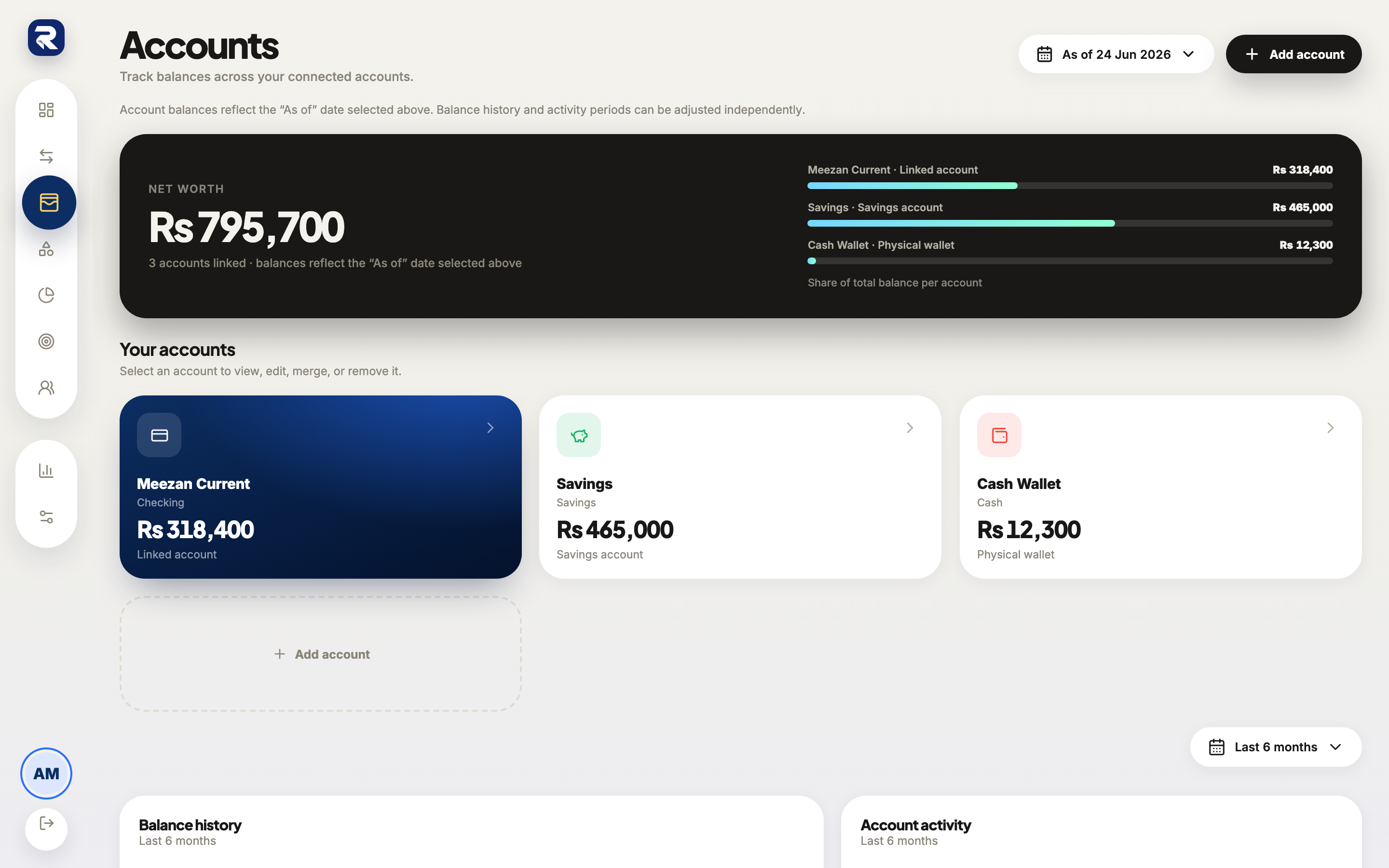
2. Withdrawals are transfers
Every ATM run, every over-the-counter withdrawal, every time somebody pays you back in notes and you keep them: a transfer from the source account into Cash. Rakama links the two legs, and the linked pair is excluded from spending, budgets, the category breakdown and every month-on-month comparison.
This is what stops the double count. The withdrawal is invisible to your spending figures; only what you do with the money afterwards is visible.
3. Purchases come out of Cash
A cash purchase is an ordinary expense with Cash chosen as the account. Same categories as your card spending — Groceries is Groceries whether you tapped or paid in notes. This is the point at which your budgets finally see the whole picture.
4. Count weekly
Once a week, count what is actually in your wallet and compare it with the balance the app shows. The difference is the sum of everything you did not record. Enter it as a single expense — category Miscellaneous, or better, whichever category you know it mostly was — and your balance is true again.
Five minutes. It replaces perfect memory with one honest measurement, and it is the entire reason this method survives contact with real life.
How much detail is actually enough
The question underneath “should I record this?” is really “would knowing this have changed anything?” That gives you a workable rule.
| Purchase | Record it? | Why |
|---|---|---|
| Rs 3,000 of groceries | Yes | Large enough to move a budget on its own |
| Rs 800 of fuel | Yes | Recurring and category-specific — the pattern matters |
| Rs 250 lunch, three times a week | Yes | Small individually, Rs 3,000 a month as a habit |
| Rs 40 for a bottle of water | No | The weekly count will absorb it |
| Rs 20 tip | No | Recording it costs more than the fact is worth |
Notice the third row. The test is not the size of one purchase but the size of the habit. Anything you do more than twice a week deserves its own category even when each instance is trivial, because the aggregate is the number you will want in three months when you ask where the money goes.
What to do when it drifts anyway
It will. A week where you forgot, a week away, a stretch where the count came out Rs 4,000 short and you have no idea why. There are exactly two honest responses and the wrong one is very tempting.
The wrong response
Editing old entries until the balance matches. This feels like tidying and is actually the destruction of your only reliable data — you are changing records you know were correct to compensate for records you know are missing.
The right response
One adjusting entry, dated today, for the difference. Your history stays as it was recorded, the adjustment is visible as an adjustment, and if adjustments start getting large you have learned something real about how much you are not capturing.
A pattern of Rs 3,000–4,000 monthly adjustments is not a failure. It is a measurement: that is your unrecorded small-purchase rate, and it is more useful known than pretended away.
Where Rakama stops
Stated plainly, so you are not waiting for features that do not exist:
- There is no cash-count screen. The weekly reconciliation is you, counting, then adding one transaction.
- There is no envelope system. Budgets are per category, not per pot of physical money.
- There is no reminder to count. Pick a day and attach it to something you already do.
- Nothing detects that your cash balance has gone stale. A cash account that has not moved in three weeks looks identical to one that is accurate.
What Rakama does supply is the part that is genuinely hard to do by hand: a cash balance that updates as you spend, transfers that stay out of your spending totals, and budgets that count cash and card purchases as the same thing. The discipline is still yours. It is just one weekly count instead of a hundred small acts of memory.
Frequently asked questions
How do I budget when most of my spending is cash?
Treat cash as an account with a balance, not as a category. Withdrawals move money into it, purchases spend from it, and a weekly count tells you whether your records are true.
Do I have to record every cash purchase?
No. Record the ones large enough to change a decision, and reconcile the rest with a weekly count. A method you actually follow beats a complete one you abandon.
Why does my cash balance never match what is in my wallet?
Almost always small unrecorded purchases. The fix is not better memory — it is a short weekly count and a single adjusting entry.
Should cash and card budgets be separate?
No. Budget by category across both. Splitting the budget by payment method tells you how you paid, which is rarely the question you have.
Make your money easier to understand.
Track expenses, plan budgets, and keep your goals in one clear view with Rakama.
Try Rakama free ↗