
No. Withdrawing cash is not spending it. Rs 20,000 out of the machine is Rs 20,000 that moved from your bank to your pocket, and you own every rupee of it on the walk home. The expense happens later, at the counter — which is exactly why so many budgets count it twice.
The short answer, and the one exception
An ATM withdrawal is a transfer: bank account out, cash wallet in. Your total is unchanged. Nothing has been consumed.
The one part of it that is an expense is the fee. If the machine charged you Rs 25 for using another bank’s network, that Rs 25 is gone and it belongs in a Fees or Bank charges category. Record it as its own small line rather than folding it into the withdrawal, or it disappears into an amount you have told the app to ignore.
Why this particular mistake is so easy to make
Because your bank agrees with the wrong answer. On the statement, a withdrawal is a debit, and it sits in the same column as the electricity bill with the same minus sign in front of it. Nothing distinguishes them, because your bank does not know your wallet exists. It can only see the account it holds.
So an app that imports a statement and treats every debit as spending is not being careless. It is being faithful to a source that is structurally incapable of telling the difference. The correction has to come from you, once, and then it holds.
The result of not correcting it is a double count that grows with how much cash you use. Withdraw Rs 20,000 and then record the Rs 3,000 of groceries, Rs 1,200 of fuel and Rs 800 of a haircut you paid for with it, and your month shows Rs 25,000 of spending against Rs 5,000 that actually happened. In a cash-heavy month the error can be larger than the real total.
What to record instead
Three lines, in this order, and only the third is spending.
- The withdrawal — a transfer from the bank account to a cash account. Amount out of one, in to the other, no category.
- The fee, if there was one — a small expense in Fees or Bank charges.
- Each purchase you make with the cash — an ordinary expense against the cash account, categorised normally.
This wants a cash account to exist, which is the step people skip. In Rakama that means adding an account of type Cash alongside the bank ones, and it then behaves like any other account: it has a balance, it appears in the account picker, and transactions can be posted against it.
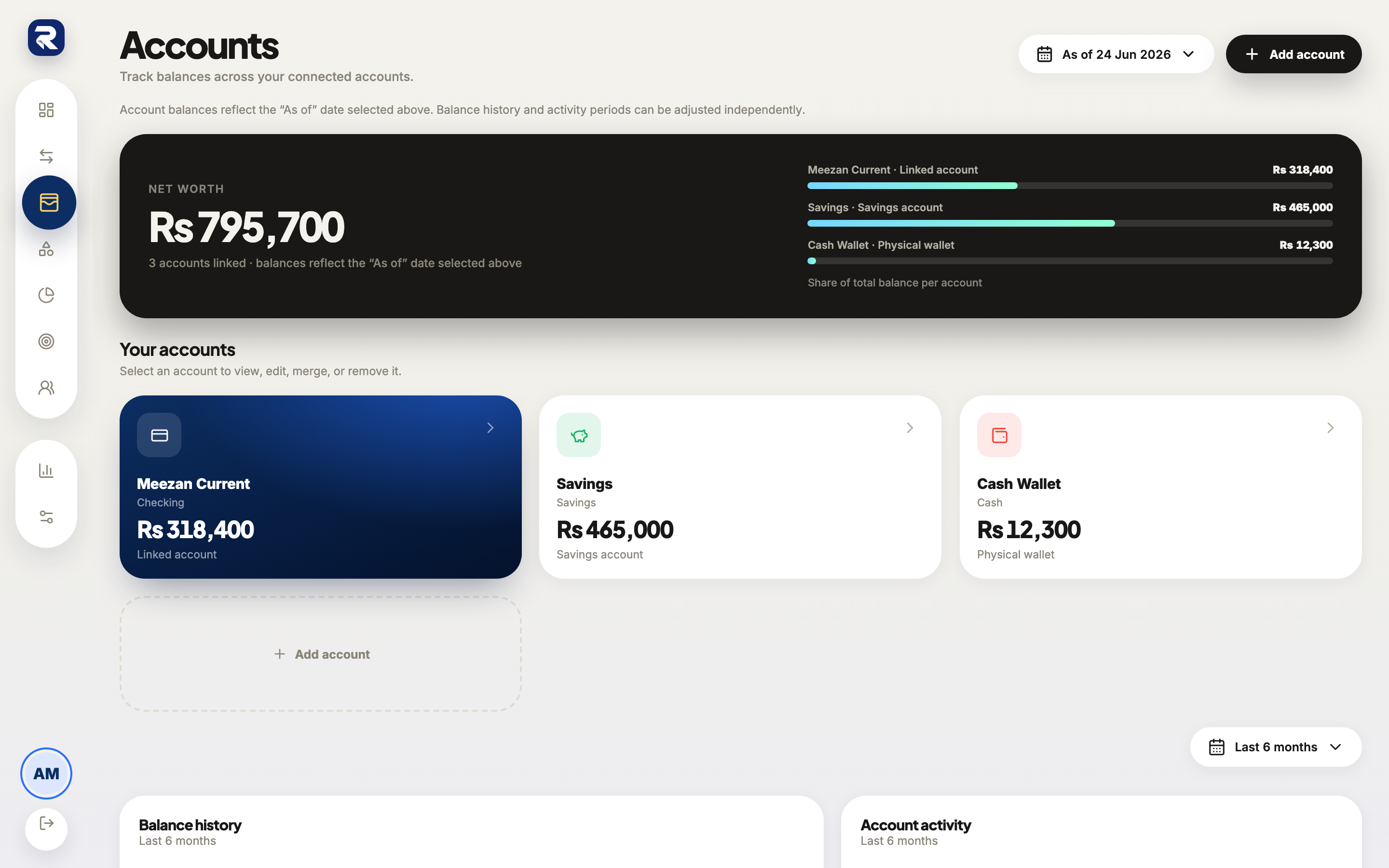
The reward is a cash balance that means something. If the app says you are holding Rs 6,400 and your wallet has Rs 6,400 in it, every cash purchase in between was recorded. If it says Rs 6,400 and you have Rs 2,000, you have found roughly Rs 4,400 of spending you never wrote down — which is useful information, not a failure.
The lazy version, which is still better than nothing
Tracking every cash purchase is the part people give up on, and giving up usually means giving up on the whole ledger. So here is the compromise, stated without judgement:
Record the withdrawal as spending, in a single category such as Cash, and record nothing else. You lose the breakdown — the app can no longer tell you that Rs 3,000 of it was groceries — but your monthly total is right, your savings rate is right, and nothing is counted twice.
The rule that matters is not which of these two methods you pick. It is that you never mix them. Half a month of tracked cash purchases on top of withdrawals recorded as spending produces numbers that are wrong in a way nobody can later untangle.
Frequently asked questions
Is withdrawing cash an expense?
No. The money is still yours — it has moved from your bank account to your wallet. It becomes an expense at the moment you hand it over for something.
Should I record the ATM fee?
Yes, separately. The withdrawal itself is a transfer; the fee is a genuine cost and belongs in a Bank charges or Fees category.
What if I never track what the cash gets spent on?
Then record the withdrawal as spending and accept that you will see one lump instead of a breakdown. That is a worse report but an honest one; what you must not do is record the withdrawal as spending and the individual purchases as well.
Does a cash wallet need to match to the rupee?
It does not. Count what is physically there once a week and post the difference as a single adjustment. A wallet that is roughly right is worth far more than one you abandoned for being exactly wrong.
Make your money easier to understand.
Track expenses, plan budgets, and keep your goals in one clear view with Rakama.
Try Rakama free ↗