
A reader once wrote in convinced Rakama had a bug: the app claimed he had spent more than he earned, three months running, while his balances had steadily gone up. Both things were true. He was moving his salary from current into savings on the 2nd of every month, and every one of those moves had been recorded as spending.
The short answer
Moving money between two accounts you own is never an expense. It is the cleanest case of money moved rather than money spent: current to savings, savings to fixed deposit, bank to wallet app, one bank to another. The total of everything you own before and after is the same number.
There is no ambiguity here and no judgement call. If both ends belong to you, it is a transfer.
The salary sweep, and why it inflates so badly
The reason this particular error is so destructive is that transfers are usually large and regular, while real spending is small and scattered. One salary sweep can outweigh three weeks of groceries.
Take an ordinary month. Rs 300,000 lands in current. Rs 150,000 goes to savings on the 2nd. Rs 20,000 comes out as cash on the 5th. Rs 40,000 clears the credit card on the 20th. Genuine spending — the things you actually consumed — is Rs 95,000.
| What the app counts | Reported spending | Reported savings rate |
|---|---|---|
| Every debit | Rs 305,000 | negative |
| Debits minus the card payment | Rs 265,000 | roughly 12% |
| Only what was consumed | Rs 95,000 | roughly 68% |
The first row is the one most imported statements produce, and it is not a small error. It is off by a factor of three, and it points the wrong way — it tells a person who is saving two thirds of their income that they are living beyond their means.
Why the two legs have to be linked
There is a tempting shortcut: record two separate transactions, one negative on the source account and one positive on the destination. The balances end up correct, so it looks finished.
It is not, because nothing in that pair says the two are the same event. The negative leg is indistinguishable from spending and the positive leg is indistinguishable from income, so your monthly totals now carry a phantom expense and a phantom earning of the same size. The savings rate is wrong in both directions at once.
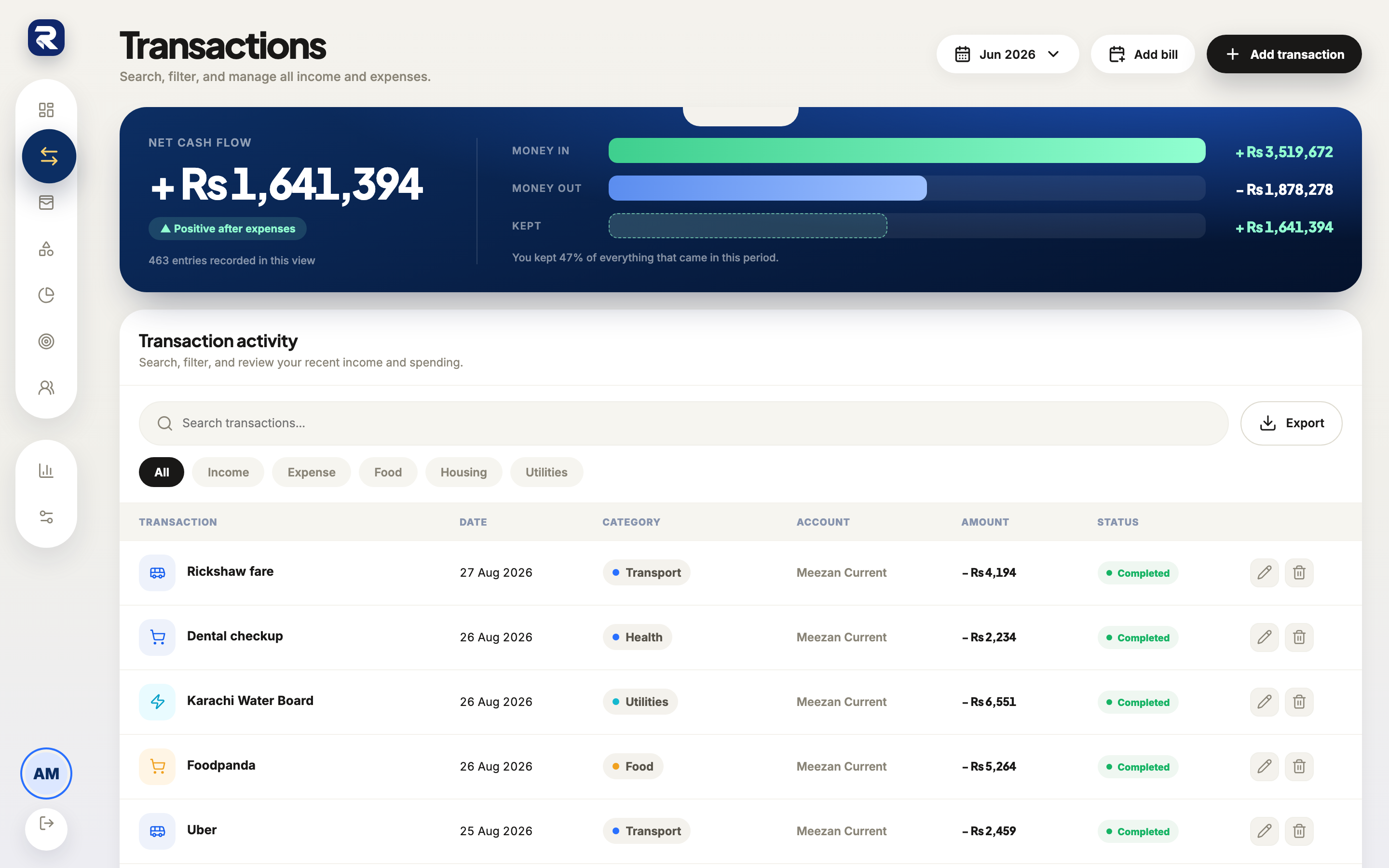
A transfer has to be one thing with two ends. Rakama records it that way — choosing Transfer writes a marker that binds both legs into a single event, and every figure derived from spending steps over the pair rather than over one half of it.
Three edges worth knowing about
The fee is real
Interbank transfers in Pakistan are often free below a threshold and charged above it. When there is a charge, it is the one component of the transaction that genuinely left you. Record it as its own expense; a Rs 200 fee hidden inside a Rs 150,000 transfer is a cost you will never see again.
Date it when it left
Transfers between banks can take a day, and month-end is where that bites. A transfer sent on the 31st and received on the 1st should still be dated the 31st. Otherwise one month ends with money that has vanished and the next begins with money from nowhere.
Two currencies is not a transfer
If the money changes currency on the way — a dollar account funding a rupee account — the two legs are not the same amount, and calling it a transfer papers over a real gain or loss. Rakama holds balances per currency and does not convert between them, which means it will not silently invent a rate for you. The honest treatment is to keep the two currencies apart and read them separately.
Frequently asked questions
Is a transfer to savings an expense?
No. Both accounts are yours, so the total you own is unchanged. It should not appear in your spending, your category breakdown, or your budgets.
How do I record a transfer between two of my accounts?
As a single transfer, naming the account it leaves and the account it arrives in. Recording it as two separate transactions works for the balances but leaves the outgoing leg looking like spending.
What about the fee on an interbank transfer?
That is a genuine expense and should be recorded separately, in a Fees or Bank charges category. It is the only part of the transaction that actually left you.
Do transfers affect my budget?
They should not, and in Rakama they do not — transfers are excluded from budget progress, income, expenses, the category breakdown and the health score.
What if the money arrives the next day?
Date the transfer when the money left. A day of drift between two of your own accounts changes nothing you will ever want to read; a transfer dated in the wrong month does.
Make your money easier to understand.
Track expenses, plan budgets, and keep your goals in one clear view with Rakama.
Try Rakama free ↗