
Open any bank statement and count the debits. Now ask how many of them made you poorer. The two numbers are not close. Salary sweeps, card bills, savings transfers, cash withdrawals and money you fronted for someone else all leave the account looking exactly like a restaurant bill, and none of them is spending. Every budget that cannot tell the difference reads high, and the person reading it concludes they are worse with money than they are.
Money moved versus money spent
There is one distinction underneath all of this, and it is worth naming because we will use it in every post that links here. Call it money moved versus money spent.
Money spent leaves your possession. After it happens, the total of everything you own is smaller. A cup of coffee, a phone bill, a plane ticket.
Money moved changes where your money sits without changing how much of it there is. Current account to savings. Bank to cash in your pocket. Your account to your other account. After it happens, the total is identical.
A bank statement cannot see this difference, because a bank only knows about one account at a time. From the current account’s point of view, the money genuinely left. From your point of view, it went upstairs. The whole job of a personal ledger — as opposed to a statement — is to hold both accounts in view at once so that the second case stops looking like the first.
The three-question test
When a transaction is genuinely ambiguous, three questions settle it in order. Stop at the first one that answers.
1. Do I still own it?
If yes, it is a transfer, full stop. Savings, a fixed deposit, a cash wallet, a second bank, a wallet app you topped up. It does not matter that you cannot spend it as easily today; ownership is the test, not convenience.
2. Is this settling something I already recorded?
A credit-card bill, a loan instalment, a friend paying you back for the dinner you covered. The spending already happened, at the moment of the purchase. Recording the settlement as spending as well counts one event twice.
3. Do I expect it back?
A security deposit on a flat, a refundable booking, money lent to a brother. This is the only one of the three where the honest answer is often I do not know. That uncertainty is a real state and it deserves its own treatment rather than a coin flip — more on that below.
The nine cases people actually get stuck on
| The transaction | Moved or spent | Why |
|---|---|---|
| Cash withdrawn from an ATM | Moved | The money is in your pocket. It becomes spending when you buy something with it. |
| Current account to savings | Moved | Same owner, different shelf. |
| Paying off a credit card | Moved | The spending was the purchase. The bill is settlement. |
| A loan repayment | Split | Principal is settlement of a debt; interest is a genuine cost. |
| Money lent to a friend | Neither, honestly | You expect it back, so it is not spending — but nothing in most apps models a debt owed to you. |
| Money sent to your parents | Spent | You do not expect it back. Treat it as the category it is: support. |
| A refund landing back | Negative spending | It should reduce the original category, not appear as income. |
| A refundable deposit | Moved, with an asterisk | You own it until the day you do not. Track it, do not spend against it. |
| A committee or ROSCA contribution | Moved | You are saving into a pot with a queue. The payout is not income either. |
Every row in that table has its own post, because every row has a wrinkle that a single line cannot carry. The lending row in particular is where honesty matters more than neatness, and we will come back to it.
How Rakama draws the line
Rakama models this in the data, not in a category you have to remember to pick. A transaction has a type, and transfer is one of the three alongside expense and income. Choosing it writes a marker that ties the two legs together — money leaving one account and arriving in the other as a single linked event rather than two unrelated ones.
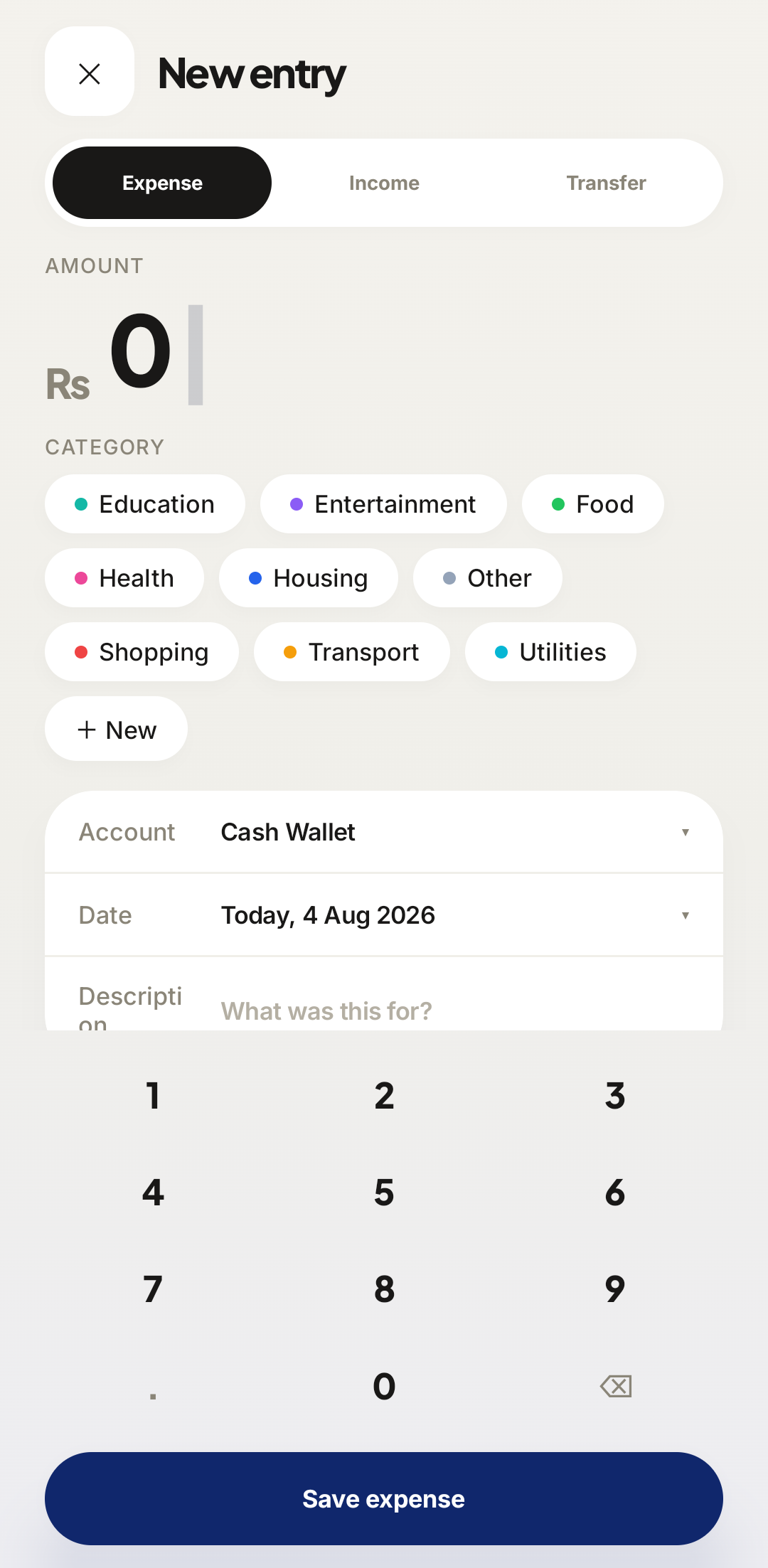
What that marker buys you is that every number derived from your spending simply steps over it. Income and expense totals, the category breakdown, budget progress and the financial health score are all computed from transactions that are not transfers. You do not have to remember to exclude anything; a transfer is invisible to all of them by construction, and it still moves both balances correctly.
Where Rakama stops
One row in the table above is not modelled, and pretending otherwise would be exactly the mistake this post is about. Rakama has no concept of a loan you have made. There is no ledger of who owes you what, no repayment schedule and no balance that goes down as they pay you back. Money lent to a brother is, as far as the app is concerned, a categorised expense.
The workable answer today is a dedicated category — call it Lent — so that at least the amount is separated from your real spending and you can read the total in the category breakdown. It is a workaround, and it is worth saying so plainly rather than dressing it up as a feature.
What actually goes wrong
The consequences of blurring the line are not cosmetic. Four things break, and they break quietly:
- Your spending total inflates. Every transfer is added to it, so a month where you moved a lot of money looks like a month where you lost control of it.
- Savings rate collapses. Move money into savings, have it counted as spending, and the app concludes you saved nothing — while you were saving.
- Category budgets fire wrongly. A transfer that lands in a spending category eats the budget for that category, and you get an over-budget warning for money you still have.
- You stop trusting the app. This is the expensive one. A number you have caught being wrong once is a number you check manually forever, and at that point the ledger has stopped saving you anything.
The fix is not effort. It is one decision made once per transaction type, and then the arithmetic looks after itself.
Frequently asked questions
Is moving money to savings an expense?
No. Your net worth is unchanged — the money is still yours, it is just sitting somewhere else. Record it as a transfer between two accounts you own, not as spending.
What is the difference between an expense and a transfer?
An expense reduces the total you own. A transfer moves money between two things you own and leaves that total exactly where it was. The test is not which account it left; it is whether you still have it.
Why does my budgeting app say I spent more than I earn?
Almost always because transfers are being counted as spending. A salary that lands in current, gets moved to savings, and then partly moved to a cash wallet can be counted three times if every outgoing line is treated as an expense.
Does it matter if I get this wrong?
Yes, and not only for tidiness. Category totals, budget progress, savings rate and any health score are all computed from what the app believes was spent. One misclassified transfer distorts all four at once.
Make your money easier to understand.
Track expenses, plan budgets, and keep your goals in one clear view with Rakama.
Try Rakama free ↗