
Here is a question with two correct answers, which is why it causes so much trouble. Is the Rs 84,000 you paid the bank on the 20th an expense? If you already wrote down the forty-one purchases that made up that bill, absolutely not — you would be counting them twice. If you never wrote down a single one, then yes, that payment is the only record of your spending that exists. What you cannot do is both.
The short answer
A credit card is a debt, and paying it is settlement. The expense happened at the till, on the day you bought the thing. The bank simply covered you in the meantime.
So the payment itself is money moved: out of your current account, into reducing a balance you owed. The only question is whether the expense side of it is already in your ledger.
Two consistent methods, and one incoherent one
Method A — record purchases as they happen
Every card purchase is an ordinary expense, dated the day you made it, categorised normally, posted against the card. The monthly payment is a transfer from your current account to the card, and it is invisible to every spending figure.
This is the better method and it is not close. Your category breakdown is real. Your budgets warn you on the 12th, while you can still do something about it, instead of on the 20th when the bill lands. And a month with heavy card use looks exactly like a month with heavy cash use, which is the point.
Method B — record only the bill
One expense a month, the amount of the payment, in a category called something like Card. Nothing else is recorded.
It is coarse — you cannot see what you bought, and your spending is reported a month late — but it is internally consistent, and for someone who would otherwise track nothing, that is worth more than an elegant method they abandon in week two.
Method C — the one that breaks everything
Recording some purchases as they happen and also recording the full monthly payment. This is what happens by default when someone imports a bank statement into an app that already has their card transactions, and it double-counts every purchase that appears on both.
Interest and fees are not settlement
Everything above concerns the principal — the part of the bill that repays what you spent. The rest of a card statement is a different animal.
- Interest on a revolved balance is a pure expense. Nothing was bought with it; it is the price of not clearing the card. Give it its own category.
- The annual fee is an expense. You consumed a year of the card.
- Late fees and over-limit charges are expenses, and worth watching precisely because they are avoidable.
- A cash advance is a transfer, plus a fee that is almost always larger than people expect, plus interest that usually starts the same day.
If you take one operational thing from this post: put card interest in a category of its own and look at the twelve-month total once a year. It is the number most likely to change a behaviour.
Doing this in Rakama today
Rakama has accounts with types and it has linked transfers, which is everything method A structurally needs. Create the card as its own account, post purchases against it, record the monthly payment as a transfer from your current account to the card, and the spending figures behave.
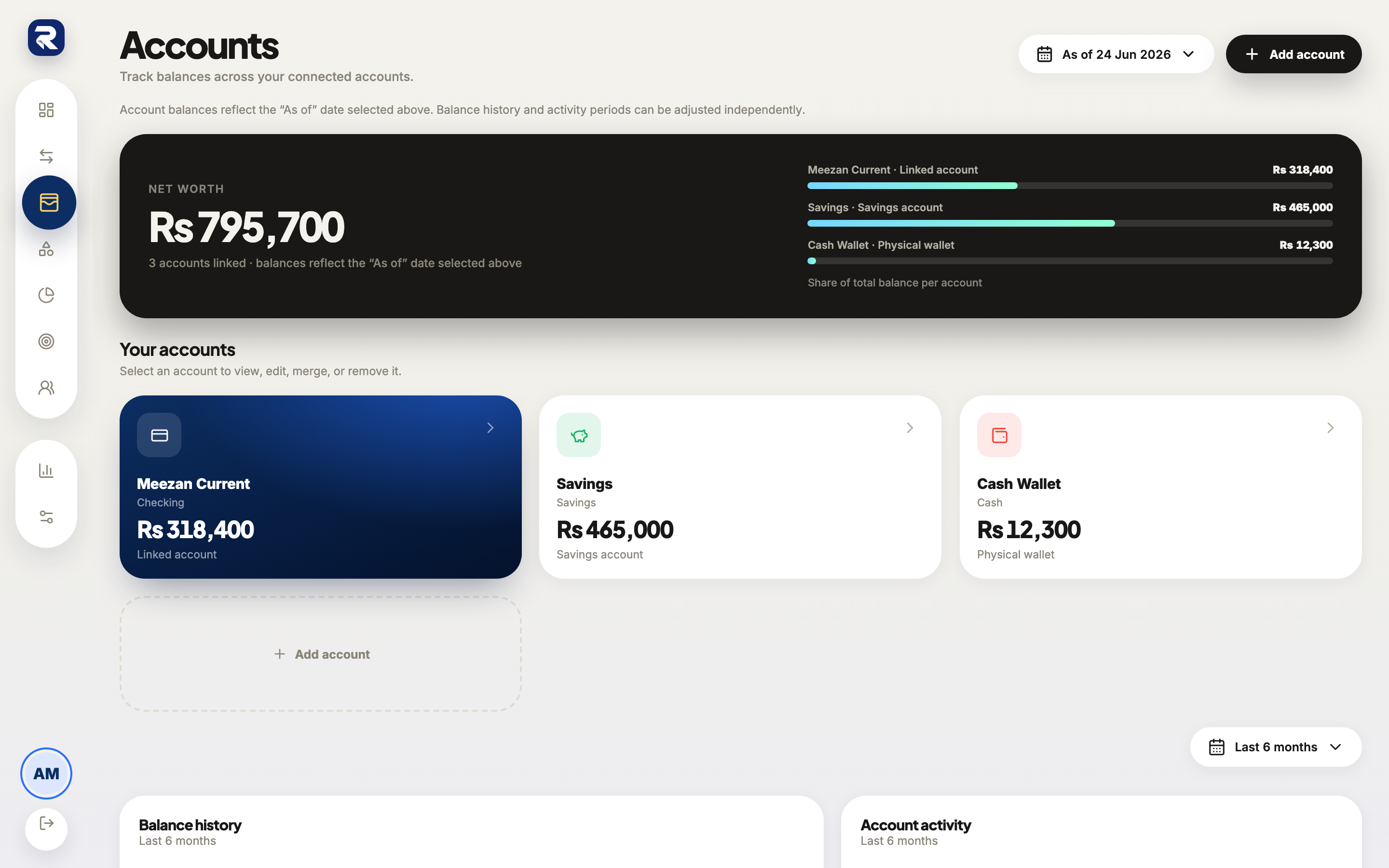
What Rakama does not do
Two honest limitations, because a post that promised otherwise would be no use to you.
There is no credit-limit concept. A card account is an account with a balance; nothing warns you as you approach a limit, and nothing computes utilisation.
And interest is not calculated. Rakama records the interest charge you enter; it does not model an APR, a statement cycle, or a minimum payment. If you want to know what carrying a balance is costing you, the app will faithfully total the charges you record and will not predict the next one.
Frequently asked questions
Is a credit card payment an expense?
No, if you already recorded the individual purchases — the payment settles a debt you have already counted. Yes, in effect, if you never record the purchases and only ever record the monthly bill.
Should I record credit card purchases when I buy or when I pay?
When you buy, if you want a category breakdown that reflects what you actually bought and a budget that warns you during the month rather than after it.
Is credit card interest an expense?
Yes, and it is one of the few costs on a statement that is purely a cost. Give it its own category so you can see the annual total; it is usually larger than people expect.
What about the annual fee?
An expense, categorised as Fees. It is not settlement of anything — you consumed a year of the card.
Make your money easier to understand.
Track expenses, plan budgets, and keep your goals in one clear view with Rakama.
Try Rakama free ↗