
A car loan instalment of Rs 38,000 leaves your account on the same day every month, as one line, from one lender, for one purpose. It is nevertheless two completely different transactions wearing a single coat — and the smaller of the two is the only part that is costing you anything.
The short answer
Interest is an expense. Principal is not.
The interest is the price of borrowing: it is consumed, it buys you nothing you keep, and it is gone. The principal reduces what you owe — your cash goes down and your debt goes down together, which leaves your net position exactly where it was. Money moved, not money spent.
Splitting the instalment
The split is not fixed. Every loan front-loads interest, so an instalment that is mostly interest in year one is mostly principal by the end.
| Year of a 5-year loan | Roughly interest | Roughly principal |
|---|---|---|
| Year 1 | the larger share | the smaller share |
| Year 3 | about half | about half |
| Year 5 | the smaller share | the larger share |
Which means a single fixed split, decided once, drifts wrong over the life of the loan. Two workable levels of effort:
The precise way
Take the amortisation schedule from your lender and record two lines each month — interest as an expense, principal as a transfer to the loan account. Correct every month, and about thirty seconds of work.
The good-enough way
Split at the current ratio and revisit once a year, on the loan’s anniversary. For a five-year loan that keeps you within a few percent of the truth throughout, which is well inside the noise of everything else in a personal budget.
Why this is worth any trouble at all
Three reasons, in increasing order of how much they matter.
Your spending is overstated. Treating the whole Rs 38,000 as an expense inflates a year’s spending by the principal — several hundred thousand rupees on an ordinary car loan — and drags your savings rate down with it, at a time when you are in fact building equity every month.
You cannot see the cost of the borrowing. Interest recorded separately gives you an annual figure. That figure is what makes a refinancing decision, or an early-repayment decision, arithmetic instead of instinct.
Progress becomes invisible. A loan is one of the few things in a budget that gets structurally better every month without you doing anything, and folding it into a lump expense hides that entirely. Four years into a five-year loan, the instalment feels exactly like it did in month one. It should not.
What Rakama can and cannot do here
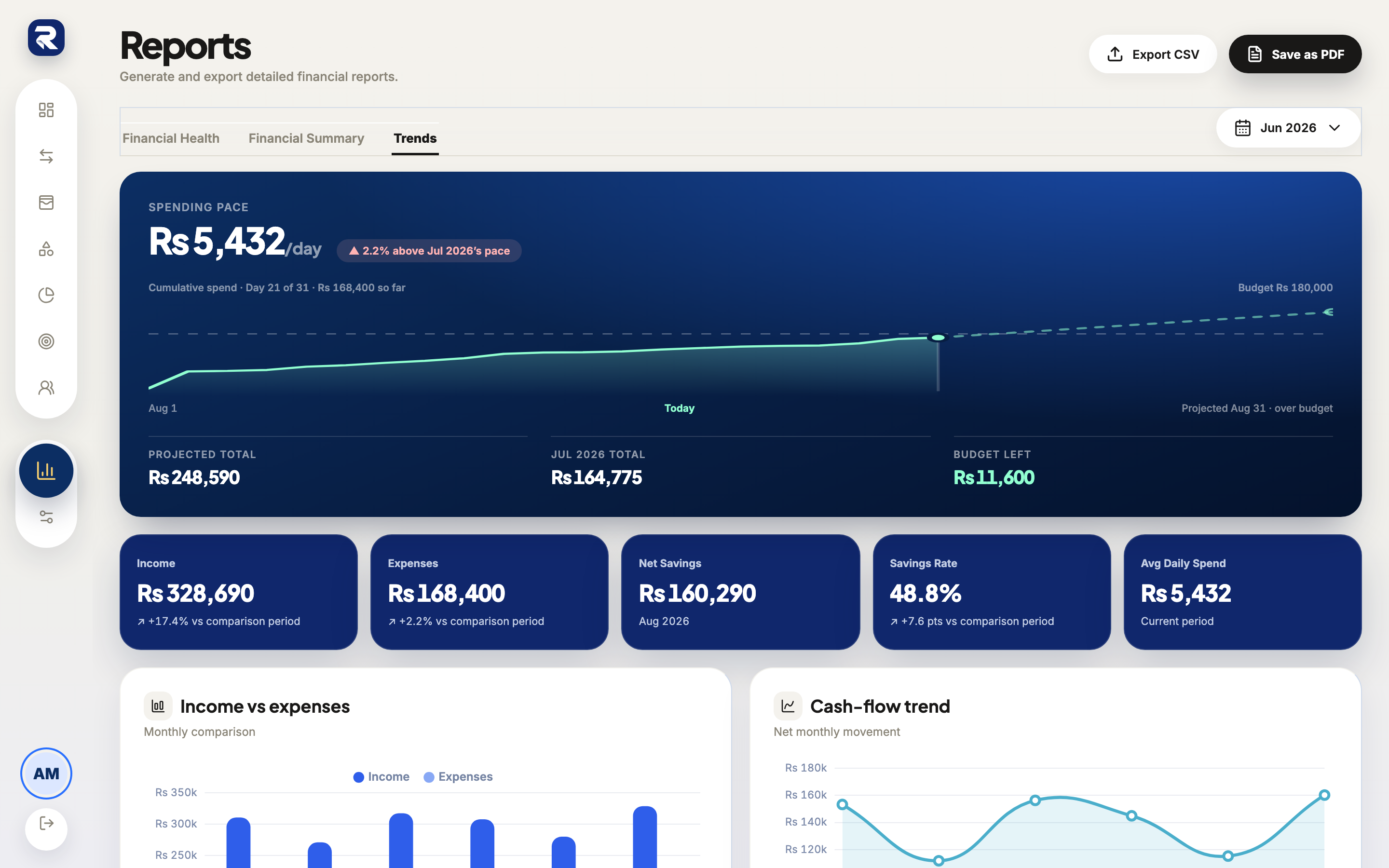
What works: create the loan as an account, record the interest portion as an ordinary expense in an Interest category, and record the principal portion as a transfer from your current account to the loan account. The loan balance moves, your spending stays honest, and the Interest category accumulates a number worth reading once a year.
The limitations, plainly
Rakama does not model loans. There is no amortisation schedule, no interest rate stored anywhere, no automatic split of an instalment, and no reminder when a payment is due. Nothing computes what you still owe from a rate and a term — the loan account’s balance is whatever your entries have made it.
That puts the schedule in your hands. In practice it means keeping the lender’s own statement as the source of truth for the split, and using Rakama for what it is good at: holding the two halves apart so that everything downstream of your spending figures stays true.
Frequently asked questions
Is a loan repayment an expense?
The interest portion is. The principal portion is settlement of a debt — money moved, not money spent — because it reduces what you owe rather than consuming anything.
How do I split a loan payment between principal and interest?
Your lender publishes an amortisation schedule, and most apps show it. If you cannot get one, split the first payment by the ratio the loan agreement implies and revisit it once a year.
Should I bother splitting a small loan?
For anything under a year, probably not — record the whole instalment as an expense and accept a small overstatement. For a mortgage or a car loan the difference is large enough to change what your budget tells you.
Does paying off a loan early count as spending?
No. A lump-sum repayment of principal is the clearest possible case of money moved: your cash falls and your debt falls by the same amount.
Make your money easier to understand.
Track expenses, plan budgets, and keep your goals in one clear view with Rakama.
Try Rakama free ↗