
Rs 50,000 to a friend for a deposit he is short on. He will pay it back after Eid. Your bank balance is Rs 50,000 lower and your budget is about to tell you that you had a catastrophic month. Neither of those facts describes what actually happened, and the gap between them is where a surprising amount of family and friendship accounting lives.
What is technically true
Nothing was consumed. You exchanged one asset — cash — for another asset: a claim on a person. On paper your net worth is identical the moment after the transfer as the moment before.
That is how a business would record it, and a business would be right, because a business has a debtors ledger, a due date, and a legal route to collect. You have a WhatsApp message and a relationship.
So the accounting answer is not an expense, and it is also not quite good enough. The useful question is not what the money is; it is what you believe about getting it back.
Loan, gift, uncertain
Three states, and it is worth being ruthless about which one applies before you type the amount in.
| State | What it means | How to record it |
|---|---|---|
| Loan | A repayment date exists, you would follow up, and you expect the money | Not spending. Park it in a Lent category so it stays out of your real totals. |
| Gift | You would not chase it and you have made peace with that | Spending. Categorise it properly — Family, Support, Gifts — and let it show. |
| Uncertain | Somewhere in between, which is where most of these actually sit | Record it as a gift, and treat any repayment as a pleasant surprise. |
Why the uncertain case is the one that matters
Nobody gets the clear cases wrong. A documented loan with a date is obviously a loan; a hundred rupees to a cousin is obviously a gift. The damage comes from the middle, and the middle is most of it.
What happens with an uncertain amount recorded as a loan is that it becomes permanent furniture. It sits in your Lent category for three years. You are not tracking it — you are not going to ask — but your ledger still believes it is coming, so your spending for that month is understated by Rs 50,000 and stays understated forever. The error does not decay. It just gets older.
Recording it as a gift is the conservative entry: you take the hit in the month it happened, your figures for that month are true, and if the money arrives later it shows up as an unambiguous good surprise. There is no version of this where you are worse off for having assumed the pessimistic case.
What you can do in Rakama today, honestly
Rakama does not model lending. There is no debtors list, no “owed to me” total, no repayment schedule, and nothing that reminds you. A loan to a friend is, to the app, an expense with whatever category you gave it.
That is a real gap, and it is worth stating instead of implying otherwise. Bill Split handles the adjacent problem — a shared cost divided between people, with each person’s share tracked and settled — but a shared dinner is not a loan, and Split will not help you with Rs 50,000 handed over for a deposit.
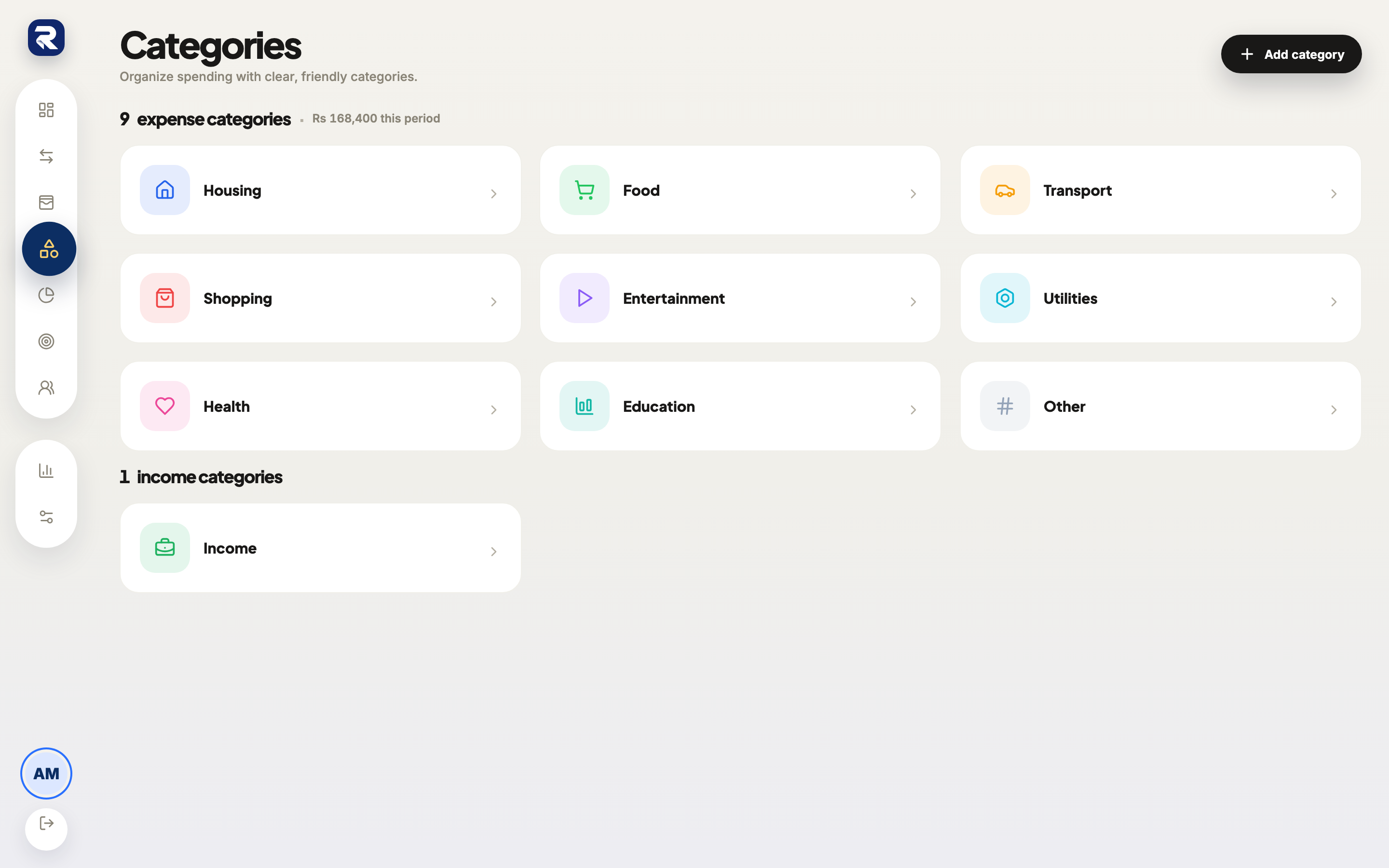
The convention that works
- Create one category — Lent — and never use it for anything else.
- Lending money is an expense in that category, with the person’s name in the description.
- Repayment is income in the same category, described the same way.
- The category total in your report is therefore what is outstanding, at any moment, without any other bookkeeping.
- Once a year, look at what has been sitting there longest and decide whether it is honestly still a loan.
It costs nothing and it survives the app not having the feature. It also has a side effect worth having: seeing the annual total in one place tends to be clarifying about who you lend to and how often it comes back.
Frequently asked questions
Is lending money an expense?
Not in accounting terms — your total wealth is unchanged, it has just moved from cash into a debt owed to you. In a personal budget the honest answer depends on how likely repayment really is.
How do I track money people owe me?
Rakama has no lending model, so the practical method is a dedicated category used for nothing else. Lending goes in as an expense in that category; repayment goes in as income in the same category, and the two net off.
Should I record a loan to family as a gift?
If you would not chase it and would not be upset if it never returned, then yes — recording it as a gift is the more honest entry, and it stops a permanent phantom asset sitting in your ledger.
What if they pay me back in instalments?
Record each instalment as income in the same category. The category total tells you what is still outstanding at any moment without any extra bookkeeping.
Make your money easier to understand.
Track expenses, plan budgets, and keep your goals in one clear view with Rakama.
Try Rakama free ↗