
There is a particular discomfort in seeing money sent to your mother sitting in a list between a fuel top-up and a food delivery, all of them described by the same flat word. The discomfort is legitimate. The classification is still correct, and the way out is not to reclassify it — it is to stop letting one word do all the work.
The short answer
It is an expense. The money left, you do not expect it back, and nothing you own has taken its place. By the same three-question test that makes an ATM withdrawal a transfer and a credit-card payment a settlement, this one comes out as spending.
What is not true is that being an expense makes it discretionary, or a failure of discipline, or a thing to be optimised down. Those are readings people bring to the word. The ledger is not making that claim.
Why it does not feel like spending
Because most spending is a choice made in a moment, and this is not. Three things separate it:
- It is not optional in any practical sense. You would cut almost anything else first.
- It does not respond to advice. No article about reducing your grocery bill has anything to say about it.
- It carries obligation rather than preference, which is exactly what a fixed cost is — and nobody feels guilty about rent.
That last one is the useful observation. Everything about how this money behaves is identical to rent: fixed, monthly, non-negotiable, paid before anything else is decided. The only difference is that budgeting advice written elsewhere has a slot for rent and no slot for this at all.
Give it a category of its own
The commonest mistake is not misclassifying it as a transfer. It is dropping it into Other, or Gifts, or Miscellaneous — categories that already hold six unrelated things — and thereby making the single largest recurring line in the budget unreadable.
Make one category. Call it Family support, or Parents, or whatever you would actually recognise in a list. Use it for nothing else. Then the annual total is a number you can look at, and the month-to-month pattern is visible instead of buried.
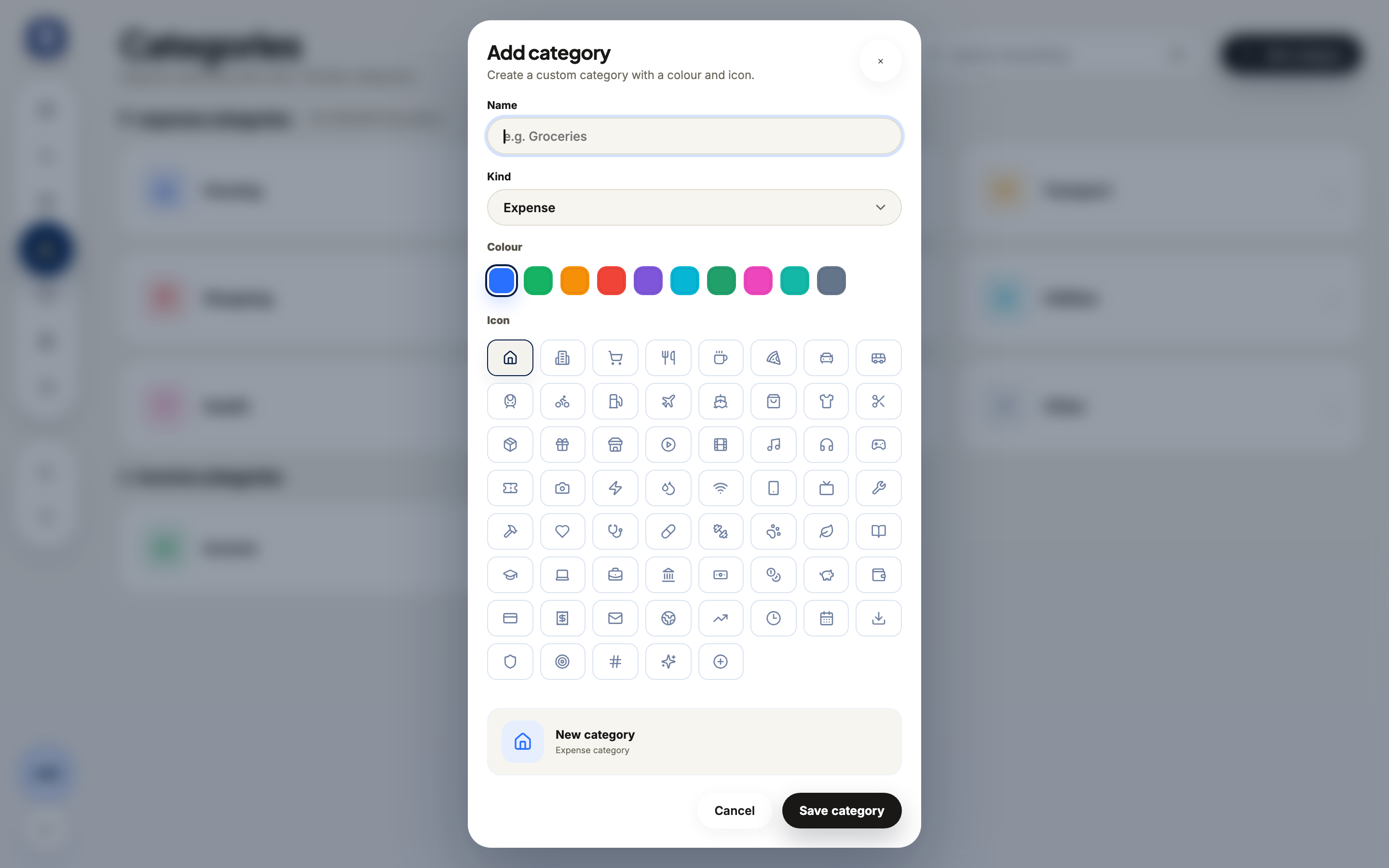
If you also send money to siblings, or cover a specific bill for the household, decide now whether those share the category or get their own. Either is fine; changing your mind in March is what makes a year of data uncomparable.
Budget it like rent
Put it in the fixed block at the top, with housing and utilities, before anything variable is allocated. Not because it is the same kind of obligation, but because it behaves the same way arithmetically, and a budget is arithmetic.
When the amount varies
Many people send a baseline and then more when something comes up — a medical bill, a wedding, a repair. Budget the baseline. Then a month where you send double is visible as a deliberate overage against a known figure, instead of dissolving into a general sense that the month went badly.
What Rakama will and will not do here
You can create the category, set a monthly budget against it, and watch progress through the month like any other. What Rakama has no concept of is a commitment — there is no obligations feature, nothing that distinguishes a fixed cost from a discretionary one in the data model, and no report that separates the two.
In practice that means the separation has to live in your category names. It is a small thing to work around and worth knowing about in advance, so you build the naming convention on day one rather than after a year of data.
Frequently asked questions
Is money given to parents an expense?
Yes. You do not expect it back and nothing of yours remains, which is the definition. It is a genuine expense — just one with a different meaning to you than a restaurant bill.
What category should family support go in?
Its own. Family support, or Parents, used for nothing else. Folded into Other or Gifts it becomes invisible, and it is usually one of the largest lines in the budget.
Should I budget for it or treat it as leftover money?
Budget for it, at the top, alongside rent. Anything paid every month without fail is a fixed cost regardless of how it feels.
What if the amount changes every month?
Budget the floor — the amount you would send in a quiet month — and let anything above it be a deliberate decision rather than a surprise.
Make your money easier to understand.
Track expenses, plan budgets, and keep your goals in one clear view with Rakama.
Try Rakama free ↗