
Six people at dinner. Five of them tap cards or send transfers, which appear in their apps by morning with the restaurant’s name attached. You put down Rs 9,000 in notes and will be paid back over the next four days, in amounts you have to remember, by people who have already forgotten.
The specific problem
It is not that shared spending is hard to record. It is that cash makes the intermediate state real. Your money genuinely left, and it will genuinely come back, and between those two moments your balance is neither wrong nor right — it is simply lower than your position.
Card payers have the same gap but never feel it, because the money left an account they were not tracking to the rupee anyway. You feel it because you can count your wallet.
When you paid the whole bill in cash
Record the full amount as an expense from your cash account, dated the day it happened. Not your share.
This bothers people, so here is the argument: your cash balance really did fall by Rs 9,000. Recording Rs 1,500 leaves your wallet Rs 7,500 lighter than the app thinks, which will corrupt your next cash count and be indistinguishable from unrecorded spending. The balance is the thing that has to stay true.
At every moment your accounts are correct. On the night, you are down Rs 9,000 because you are. Four days later you are down Rs 1,500 because that is your actual share.
What this does to your category totals
It inflates the dining-out category by other people’s money and then offsets it with income, which is not perfect. The alternative — a category that reads correctly but a balance that does not — is worse, because the balance is the number you can check against reality and the category total is not.
If it bothers you, record the repayments as a negative expense in the same category rather than as income. Rakama will take it; the total then reads as your true share and your income figure stays clean.
When someone else paid and you owe them
Record nothing on the night. No money has left you.
When you hand over your share — usually in cash, usually the next time you see them — that is the expense, dated then, categorised as whatever it was for. One entry, for the amount you actually paid, on the day you actually paid it.
Resist the urge to record it on the night of the dinner “so you do not forget”. An expense dated before the money moved makes your balance wrong for the intervening days, and you will forget you did it.
Settling up
For a one-off dinner, the two rules above are the whole system. For anything recurring — a shared flat, a trip, a household float — Rakama’s Bill Split is what the feature exists for.
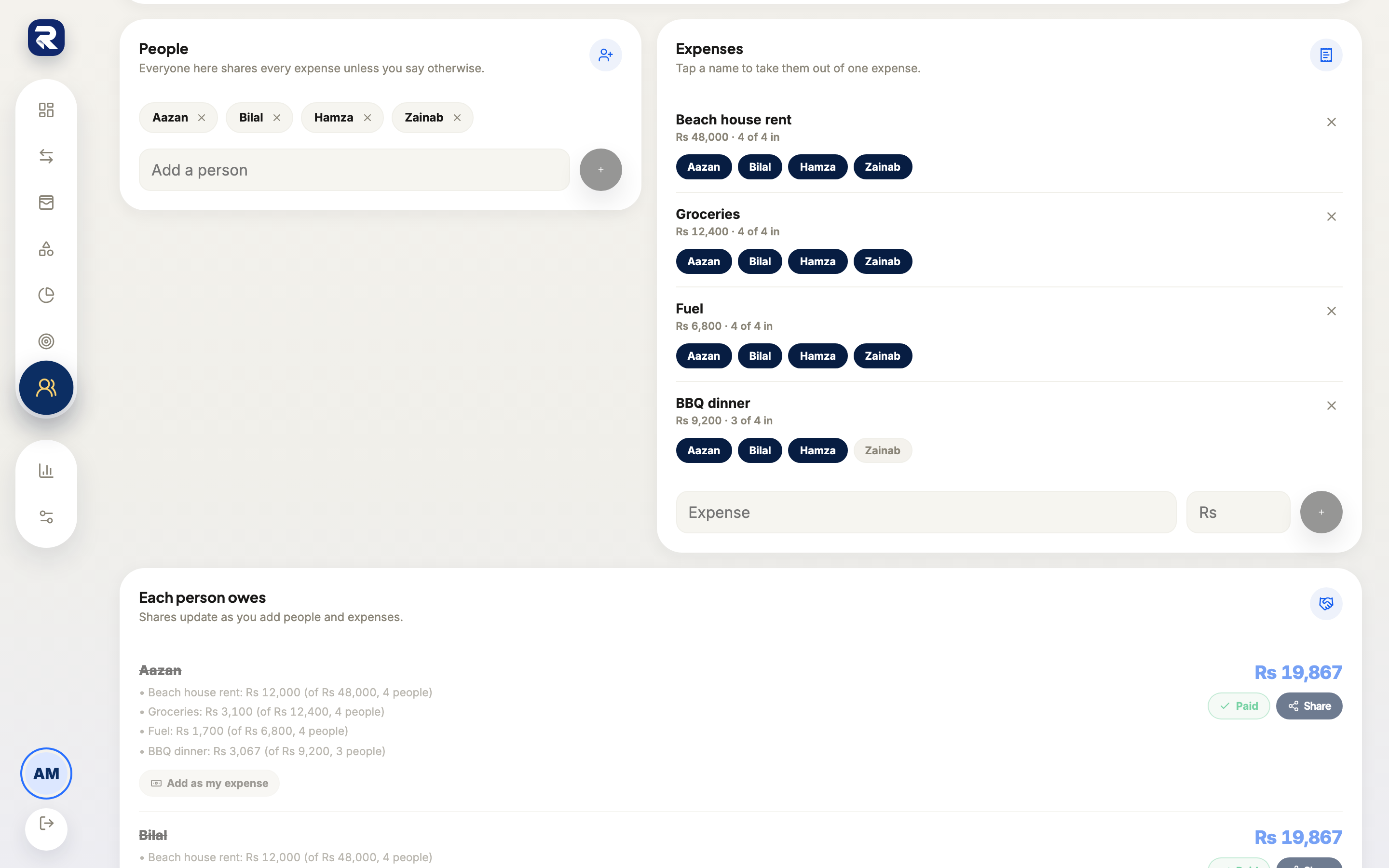
- A split holds the total, the participants and each share, so nobody relitigates the arithmetic a week later.
- It does not send reminders, does not connect to anyone else’s account, and does not transfer money.
- Marking a share settled records the fact. Recording the cash arriving in your wallet is still a separate entry.
That last line is the one people trip on. A settled split and a recorded repayment are two different statements: one is about the agreement, the other is about your balance. If you only do the first, your next cash count will be short by exactly the amount you were paid back.
Frequently asked questions
I paid a shared bill in cash — how do I record it?
Record the full amount as an expense from your cash account, then record each repayment as income when it arrives. Your net position ends correct at every point in between.
Should I only record my share?
No. Your cash balance genuinely dropped by the whole amount, and recording only your share leaves the balance wrong until everyone pays you back.
Does Rakama track who owes me?
Bill Split records the shares of a split and what each person owes. It does not chase anyone or hold a running balance per friend outside a split.
What if nobody ever pays me back?
Then the expense you already recorded is correct as it stands. Nothing further to do — which is one advantage of recording the full amount up front.
Make your money easier to understand.
Track expenses, plan budgets, and keep your goals in one clear view with Rakama.
Try Rakama free ↗